The Bodyweight-Only Ceiling: Why Calisthenics Progress Stalls Without Added Load Eventually
Quick Answer: Yes, there’s a real ceiling. Bodyweight resistance is capped by what you weigh, and advanced progressions add difficulty through leverage tricks rather than load — a finite toolbox. Past it, adding external weight to the same movements is the fix, not switching methods.
Beginner calisthenics content promises the world, and for two or three years it delivers. Then one day you knock out a set of archer pull-ups, put your feet down, and realize nothing about that felt hard.
Nobody warned you the progressions could run out. They can.

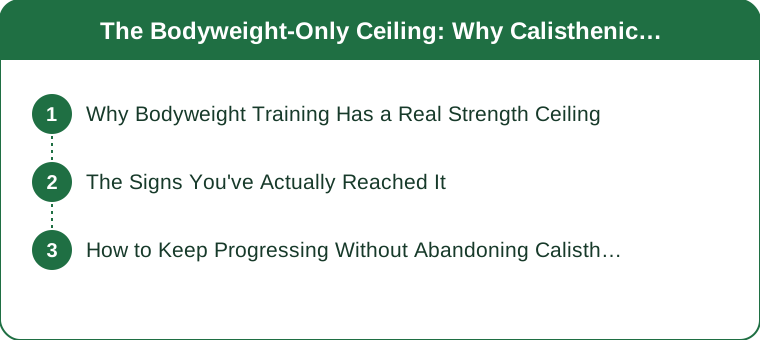
Why does bodyweight training have a strength ceiling at all?
It’s physics, not philosophy. The resistance available in a bodyweight exercise is capped by however much your body weighs, while external weight training can keep adding load essentially indefinitely.
Advanced bodyweight progressions get around this by changing leverage or movement complexity rather than adding actual load. That works brilliantly — until you’ve spent the leverage budget.
Once you reach the hardest realistic variation of a movement — a genuine one-arm progression, say — there are very few remaining ways to increase relative resistance. And past a certain point, muscle growth specifically benefits from progressively heavier external load in a way leverage variations struggle to replicate efficiently.
None of that makes calisthenics an inferior method. It’s a fixed-load reality that applies to any fixed-load training, and it sits far above where most training goals actually live.
How do you know you’ve actually hit the ceiling?
There’s a difference between a normal plateau and the ceiling. These five signs together point at the real thing:
- You complete the hardest realistic progression without genuine struggle. Archer pull-ups, one-arm push-up progressions — done cleanly, not grinding.
- Progress has clearly slowed over months, with training volume and consistency unchanged.
- The movement library feels exhausted for a given pattern. There’s no obvious next step left inside a pure bodyweight approach.
- Your goal has shifted toward maximum strength or visible muscle size specifically — goals external load serves more efficiently past a point.
- You’ve been stuck on one progression step for months despite deliberate practice, not weeks.
One of those alone is usually just a plateau. All five is a ceiling.

What Nobody Tells You
The ceiling arrives earlier for pushing than pulling. Push-ups run out of useful leverage variations well before pull-ups do, because you can keep making a pull harder by removing hands and adding range. Most people hit a pressing wall first and conclude the whole method has failed.
A weighted vest is not a betrayal. There’s a strange purity culture around bodyweight training that treats a dip belt as defeat. It’s the same movement, the same skill, one extra variable. Nobody calls a runner a quitter for buying shoes.
Skill work and strength work are separate goals. Handstands, levers, and flag progressions aren’t primarily strength builders past a point — they’re skill and control practice. Chasing them for hypertrophy is why some very strong people stop growing.
The finite toolbox is a feature below the ceiling. For the first several years, leverage progression is genuinely the most efficient path there is — no equipment, infinite variation, and real strength gains. The ceiling is the price of a very long free ride.
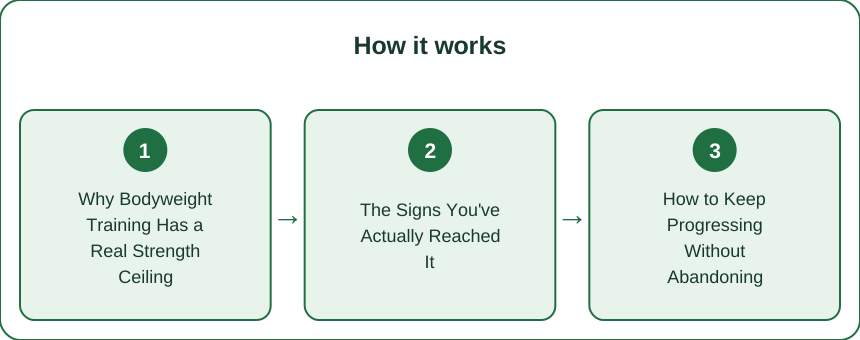
How do you keep progressing without abandoning calisthenics?
Add external load to the same movements. A weighted vest or dip belt extends pull-ups, dips, and push-ups past the bodyweight ceiling. You’re not changing exercises — you’re changing one variable.
Treat it as an extension, not a replacement. Weighted calisthenics still rests on the same skill-based, bodyweight-pattern foundation. The technique you built transfers directly.
Split skill work from loaded strength work. Keep pure bodyweight practice — handstand progressions, levers, flag work — for skill and mobility. Use loaded variations for continued strength and size.
Keep the equipment minimal. A vest, a dip belt, and a set of resistance bands is genuinely enough. This doesn’t have to become a full pivot to barbell training.
Be honest about the exceptions. For maximum absolute strength specifically, barbell work is more efficient past a certain point. Choosing it is a tool choice, not an admission that calisthenics failed.
If you’re managing a shoulder, elbow, or wrist issue, add load under guidance from a physical therapist rather than testing the ceiling yourself. Weighted dips in particular are unforgiving of an unhappy shoulder.
FAQ
How much weight should I start adding?
Small. Something in the range of 5–10 lb on a vest or belt, held for the same rep range you already own cleanly, is a reasonable first step. If your reps drop by more than about a third, you added too much.
Is this the same as a normal calisthenics plateau?
No, and the distinction matters. A standard plateau usually resolves with a deload, better sleep, or a programming change. The ceiling doesn’t resolve — it needs an added variable.
Do I have to give up bodyweight-only training?
Not at all. Plenty of people stay bodyweight-only for life and keep improving at skills, endurance, and control. The ceiling only binds if your goal is specifically more maximum strength or more muscle.
TL;DR:
- Bodyweight resistance is capped by body mass; advanced progressions buy difficulty with leverage, and that toolbox is finite.
- Five signs of the real ceiling: hardest variations feel easy, months of slowed progress, no next progression, a goal shift to max strength or size, and a long stall on one step.
- The fix is external load — vest or dip belt — on the same pull-ups, dips, and push-ups.
- Treat loading as an extension of calisthenics, not a replacement for it.
- Keep skill work (handstands, levers) separate from loaded strength work.
- Barbell training is genuinely more efficient for maximum absolute strength; that’s a tool choice, not a failure.
Keep Reading
This article is for general informational and styling purposes only. Fit, sizing, and product availability may vary.