How Resistance Bands Bridge the Gaps Bodyweight-Only Calisthenics Can't Close
Quick Answer: Bodyweight-only calisthenics can plateau when a movement (like a first pull-up or a pistol squat) requires more strength than your current bodyweight ratio allows, and resistance bands solve this by letting you train the exact movement pattern at a reduced, adjustable load rather than an all-or-nothing bodyweight jump.
You’ve hit the classic calisthenics wall — strong everywhere except the one movement that seems to require an amount of strength bodyweight training alone hasn’t built yet. Bands exist specifically for this gap.

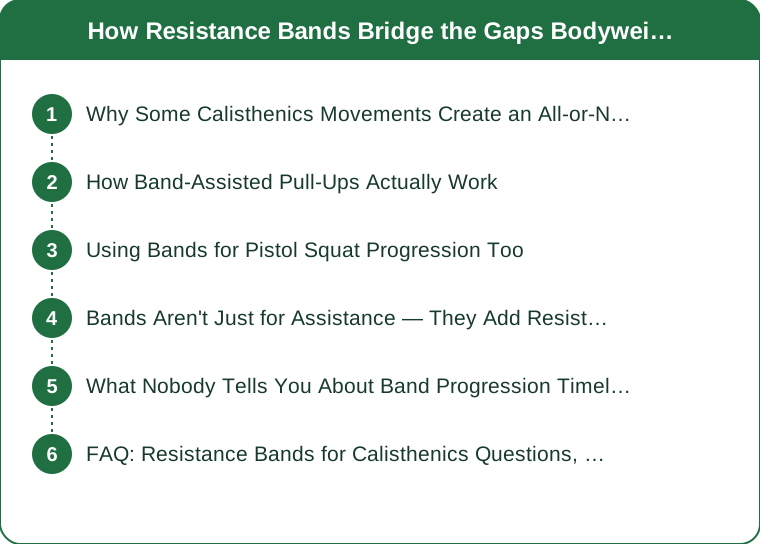
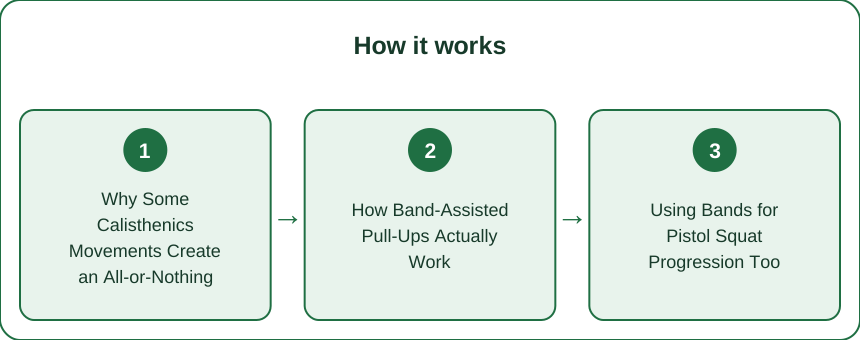
Why Some Calisthenics Movements Create an All-or-Nothing Wall
Unlike weighted exercises where you can gradually add small increments of resistance, many bodyweight movements only have one ‘weight’ — your full bodyweight — meaning there’s no small step between ‘can’t do it’ and ‘can do a full rep,’ which is exactly where band-assisted progressions fill the gap with adjustable load.
How Band-Assisted Pull-Ups Actually Work
Looping a resistance band around the bar and under your foot or knee provides a counterforce that reduces the effective weight you’re lifting, and using progressively thinner (less assistance) bands over weeks lets you gradually approach a true first unassisted rep rather than staying stuck at zero.
Using Bands for Pistol Squat Progression Too
Holding a band anchored overhead for light assistance during a pistol squat lets you practice the full range of motion and balance demands of the movement before your unassisted single-leg strength is fully there, which builds the movement pattern and strength simultaneously rather than sequentially.

Bands Aren’t Just for Assistance — They Add Resistance Too
The same bands that assist a pull-up can be used to add resistance to other calisthenics movements (banded push-ups, banded dips), which matters once bodyweight alone becomes too easy for a given movement but you’re not ready to add external weight like a dip belt.
What Nobody Tells You About Band Progression Timelines
Progressing through band thicknesses toward a full unassisted rep isn’t linear — some weeks feel like clear progress and others feel stuck at the same band, which is a normal part of neuromuscular adaptation rather than a sign the method has stopped working.
FAQ: Resistance Bands for Calisthenics Questions, Answered
How long does it typically take to progress from a heavily assisted band to no band at all?
This varies widely by starting strength level, but many people see meaningful progress over 8-12 weeks of consistent, progressive band training toward a first unassisted rep.
Can bands replace bodyweight training entirely?
No — bands are a bridging tool for specific plateaus, not a replacement for bodyweight training as a whole; most calisthenics training should still be primarily bodyweight-based.
Do I need multiple band thicknesses to make this work?
Yes, ideally — a set of 2-3 bands ranging from heavy assistance to light assistance allows the gradual progression that makes band training effective, rather than a single band that stays at the same difficulty.
TL;DR:
- Bodyweight-only movements can create an all-or-nothing strength wall bands help bridge
- Band-assisted pull-ups and pistol squats let you practice full range of motion at reduced load
- The same bands can add resistance once bodyweight movements become too easy
- Progress through band thicknesses isn’t linear, and that’s a normal part of the process
Bands aren’t a shortcut around calisthenics strength-building — they’re a tool for practicing the exact movement pattern at a load your current strength can actually handle.
Keep Reading
This article is for general informational and styling purposes only. Fit, sizing, and product availability may vary.