Why Your Bodyweight Strength Changes When Your Weight Changes
Quick Answer: In bodyweight training, your body is the load — so weight change alters the resistance directly. But it is not linear. Vertical pulling moves like pull-ups respond most sharply to weight change because you lift nearly all of yourself. Push-ups and dips respond less, because you only lift a fraction and because leverage matters more than mass. And weight change almost always comes with strength change, in the same direction or the opposite, which is why the numbers rarely move the way arithmetic predicts.
Down three pounds and suddenly the sixth pull-up is there. Up two pounds and the push-up numbers are identical.
Both are normal, and the reason is more interesting than it sounds.

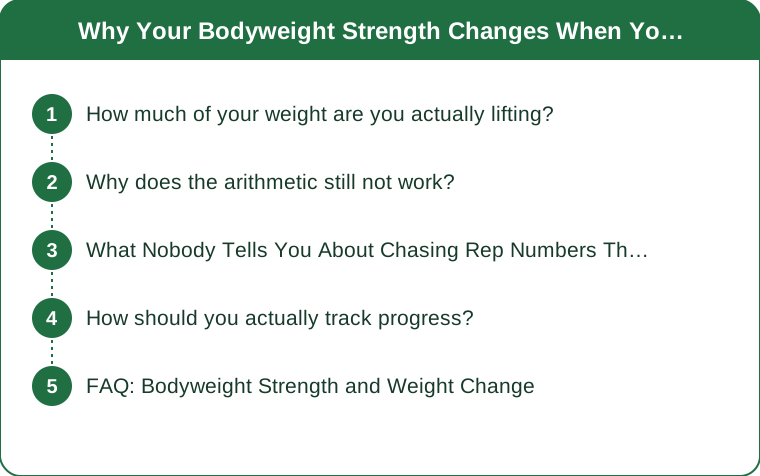
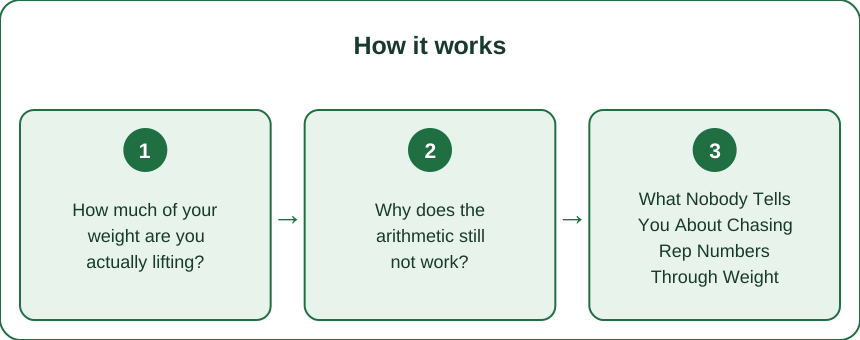
How much of your weight are you actually lifting?
This is the number that explains most of it.
A pull-up lifts roughly 95 to 100 percent of your bodyweight. Your arms are on the bar, so nearly everything else goes up. A one-kilogram change is a one-kilogram change in load.
A push-up at the bottom position lifts around 65 to 70 percent of bodyweight, because your feet stay on the floor and carry the rest. The same one-kilogram change is now about 0.65 kilograms of extra load.
An incline push-up at bench height drops to roughly 50 percent, and higher inclines drop further.
A dip is around 90 percent, close to a pull-up.
A squat at bodyweight lifts about 80 percent, because your lower legs stay under the load rather than being lifted by it.
So the same two-kilogram change is felt as a full two kilograms in your pull-up and barely more than one in your push-up. That difference alone accounts for why pull-up numbers are the first thing to move when weight moves, in either direction.
Why does the arithmetic still not work?
Because weight rarely changes on its own.
If you lost weight through a calorie deficit, you likely lost some lean mass alongside fat, and you were probably training in a slightly under-recovered state for weeks. Load went down, but so did your capacity to produce force. The net effect on pull-ups is usually still positive, because pull-ups are so load-sensitive. The net effect on push-ups is often flat or slightly negative, because you removed less load and lost some of the muscle producing the push.
If you gained weight through training and eating enough, you gained lean mass — the load went up but so did force production. This is why people who add three kilograms of muscle often keep their push-up numbers exactly and lose one or two pull-ups. The pull-up is paying the full tax; the push-up is not.
There is also a leverage factor that has nothing to do with mass. Limb length, torso length, and where your mass sits change the moment arms in every bodyweight movement. Two people at identical weight can find the same push-up meaningfully different, and a change in where your body carries weight can shift your numbers without the scale moving much at all.
And finally: skill. Bodyweight movements are coordination-heavy. Over any period long enough to change your weight, you have also practiced. That practice effect is often larger than the load effect and it points in a helpful direction regardless of which way the scale went.

What Nobody Tells You About Chasing Rep Numbers Through Weight
People notice this relationship and reach an obvious conclusion: lose weight, get more pull-ups. It works, up to a point, and then it stops working in ways worth knowing about.
The load benefit has a floor. Below a certain point you are removing tissue that was producing force, and pull-ups start going down again. Where that point sits is individual, and the only useful signal is your own trend — if reps stop improving as weight keeps dropping, you have passed it.
Grip and connective tissue do not care about your weight. A common experience is losing weight, gaining pull-ups quickly, and then hitting a wall that has nothing to do with load — the hands give out, or the elbows complain. Those tissues adapt on a slower timeline than muscle and much slower than weight loss.
Push and pull diverge. If you optimise your weight for pull-ups you may quietly stall your push-up and dip progress. Bodyweight training rewards balanced attention, and the scale is a single number pulling in one direction.
Deficit training is under-recovered training. Strength gains slow in a calorie deficit even when rep numbers rise, because the reps are rising for load reasons, not strength reasons. That is fine as long as you know which one is happening. It becomes a problem when the deficit ends, the weight returns, and the reps disappear — because the underlying strength was never actually built.
The honest framing: weight change moves your rep numbers, training moves your strength, and only one of those is durable.
How should you actually track progress?
Use measures that separate load from strength.
Track the hardest variation you can do, not the rep count. Moving from an incline push-up to a floor push-up to a decline push-up is unambiguous progress in a way that going from 12 to 14 reps is not.
Log bodyweight alongside reps. Not to control it — just so that when reps jump you know whether load or strength moved. Two columns in a notes app is enough.
Use time under tension for holds. A hollow hold, a plank, or a dead hang measured in seconds is far less sensitive to small weight changes than a max-rep set, so it gives you a cleaner signal.
Add external load once you are past ten reps. A weighted pull-up or push-up turns bodyweight training into a normal strength progression where the load is under your control instead of on the scale. This is also the point where most people’s bodyweight-only progress stalls anyway.
Compare like with like. Same time of day, similar sleep, similar amount of food in you, same bar or same floor. The day-to-day swing from those variables is larger than a kilogram of bodyweight.
Seasonally, one practical note: heading into autumn, most people’s weight drifts slightly upward and their training moves indoors onto harder, colder surfaces. If your numbers dip in October, check the surface and the room temperature before you blame the scale.
FAQ: Bodyweight Strength and Weight Change
How much weight change is enough to notice in pull-ups?
Around two to three percent of bodyweight is usually where people notice a clear difference in a max set — so roughly 1.5 to 2 kilograms for many people. Below that, normal day-to-day variation swamps it.
Do pull-ups get harder if I gain muscle in my legs?
Yes, slightly. Leg mass is essentially dead weight in a pull-up — you lift it and it contributes nothing. This is a real trade-off, not a myth, though it is a small one compared with training quality.
Should I lose weight to get my first pull-up?
Not as the primary strategy. Eccentrics, band-assisted reps, and heavy rows build the strength that a first pull-up requires, and they keep working afterwards. Weight loss can help at the margin but it is a much slower lever with more side effects.
TL;DR:
- Bodyweight moves lift different fractions of you: pull-ups around 95 to 100 percent, push-ups around 65 to 70 percent, dips around 90.
- That is why pull-up numbers move first and most when your weight changes.
- Weight change almost never happens alone — lean mass, recovery and practice all move at the same time and often mask the load effect.
- Track hardest variation, holds in seconds, and eventually added external load, rather than raw rep counts.
The useful mental model: the scale changes the resistance, training changes the engine. Watch both, but only one of them is the thing you are actually building.
This is general information, not medical advice.
Keep Reading
This article is for general informational and styling purposes only. Fit, sizing, and product availability may vary.