Why Your Rows Progress Fast and Your Pull-Ups Do Not
Quick Answer: Rows progress faster because you control the load continuously by changing your body angle, the movement is horizontal so the demand on the lats in their weakest range is lower, and the scapular mechanics are fundamentally different from a pull-up. A row is not a scaled pull-up, so row strength transfers to pull-ups only partially. To move the pull-up you need vertical pulling in the range where you fail - which usually means eccentrics and dead hangs, not more rows.
This is one of the most common plateaus in bodyweight training and one of the most misdiagnosed. People assume weak back muscles. Usually the back is fine and the specificity is wrong.

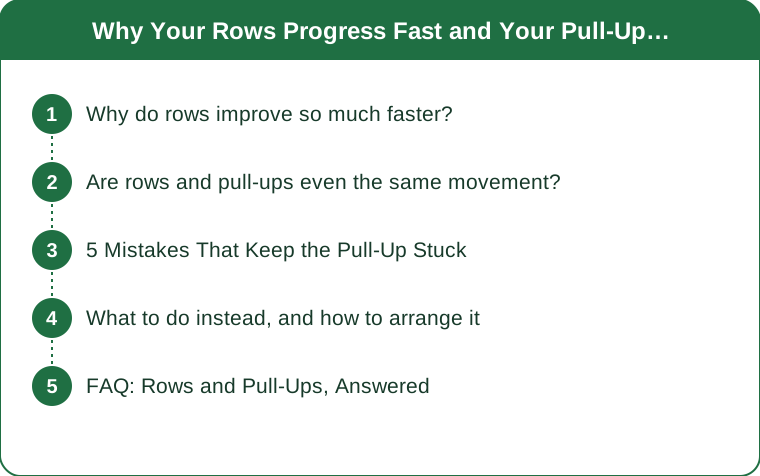
Why do rows improve so much faster?
Because the load is continuously adjustable and the pull-up’s is not.
In an inverted row, moving your feet a few inches changes the percentage of bodyweight you are lifting. You can find a resistance that lets you fail at eight to twelve reps every single session, which is exactly the condition under which strength and hypertrophy adapt fastest. The row is effectively a machine with infinite settings.
A pull-up has one setting: all of you. If that setting is above your current capacity, you get zero reps, and zero reps is zero training stimulus. If it is just at your capacity you get one or two ugly reps, which is a poor stimulus for a different reason. Progressive overload requires a load you can move for meaningful volume, and for many people a full pull-up sits outside that window entirely.
The second factor is the strength curve. In a horizontal row, the hardest point is at the top, where your arms are bent and mechanically strong. In a pull-up, the hardest point is at the bottom, where your arms are straight, your lats are at their longest, and your shoulder is at its least mechanically advantaged. Those are opposite problems. Getting stronger at the top of a row does very little for the bottom of a pull-up.
The third factor is bodyweight distribution. In a row your feet are on the ground, taking part of your weight and offering a stable base. In a pull-up nothing is supporting you and the core has to prevent swinging while the shoulders work. That stabilisation demand is a real component of the exercise and it is largely absent from rows.
Are rows and pull-ups even the same movement?
Not really, and this is the part that reframes the whole plateau.
Different planes. A row is horizontal pulling; a pull-up is vertical pulling. They emphasise different muscles: rows load the mid-back heavily - rhomboids, mid-trapezius, rear deltoid - alongside the lats. Pull-ups load the lats far more, particularly through the first third of the movement, and involve the lower trapezius and the serratus in a different pattern.
Different scapular mechanics. A row is dominated by scapular retraction - pulling the shoulder blades together. A pull-up requires scapular depression and downward rotation - pulling the shoulder blades down and around the ribcage. The muscles that depress the scapula are trained only lightly in a row and are frequently the actual limiting factor in a pull-up.
This is why the first inch is where people fail. If you hang from a bar and cannot initiate the movement - if nothing happens until you kick - the limitation is scapular depression, not arm or lat strength. A person who can do fifteen inverted rows and cannot initiate a pull-up almost always has this specific gap.
Different grip demand. Hanging from a bar loads the grip isometrically for the whole set, and grip is a common hidden limiter. In a row your hands are supporting a fraction of your weight at a much friendlier angle.
What does transfer: general upper-back strength, elbow flexor strength, and connective tissue robustness. That is not nothing, and rows are worth doing on their own merits. It is just not the thing that adds a pull-up rep.

5 Mistakes That Keep the Pull-Up Stuck
1. Training only in the range you are already strong in. Assisted pull-ups with a heavy band give the most assistance at the bottom - precisely where you are weakest - and the least at the top, where you are already fine. You end up training the part that does not need it. Use a lighter band than feels comfortable and accept fewer reps.
2. Doing more reps of things you can already do. Twenty inverted rows is a cardio set at that point, not a strength stimulus. When rows get easy, make them harder - feet elevated, one leg, slower tempo, weighted - rather than adding reps.
3. Never hanging. Dead hangs build grip endurance and, more importantly, teach the shoulder to organise under load in the exact position where the pull-up starts. Three sets of a passive hang followed by an active hang - shoulders pulled down without bending the elbows - twice a week produces noticeable change in a month, and almost nobody does it.
4. Skipping eccentrics because they feel like cheating. You are considerably stronger lowering than lifting. Jumping to the top and lowering slowly over five to eight seconds lets you train the full range under real load, including the bottom third. This is the highest-return exercise for a stuck pull-up and it works precisely because it is not a scaled-down version - it is the actual movement.
5. Attempting maximum-effort pull-ups every session. Repeatedly failing at one rep produces fatigue and very little adaptation. Test occasionally; train with methods that let you accumulate quality volume.
The third one catches most people out - hanging feels too passive to be training, and it addresses the exact mechanism that stops the first inch of the movement.
What to do instead, and how to arrange it
The principle is specificity: to get better at hanging from a bar and pulling yourself up, you need to hang from a bar and pull.
Eccentric pull-ups, twice a week. Three to five sets of three to five reps, each lowering taking five to eight seconds under control. Step or jump to the top position. Stop the set when the lowering becomes a drop rather than a descent - the controlled part is the training, and uncontrolled reps are just wear.
Scapular pull-ups. Hang with straight arms and pull your shoulder blades down without bending the elbows. The movement is small - a couple of inches - and it directly trains the depression pattern that initiates a real pull-up. Two or three sets of six to eight, and expect it to feel strange for the first week.
Dead hangs. Accumulate sixty to ninety seconds across two or three sets. Passive first, then active. Grip and shoulder organisation both improve, and neither is trained by rows.
Band-assisted pull-ups with a light band. Once eccentrics are comfortable, add these for volume in the concentric direction. Use the lightest band you can complete three to five reps with. Progress by moving to a lighter band, not by adding reps on the same one.
Keep the rows. Two sets, made progressively harder, twice a week. They build the mid-back and elbow flexors and they keep your pulling balanced against pressing. They are just not the pull-up driver.
Arrange it as: two pulling sessions a week, each with an eccentric or assisted vertical pull first while fresh, then rows, then hangs at the end. Vertical pulling goes first because it is the thing you are trying to improve, and whatever you do first gets your best effort.
Give it eight weeks before judging. Pull-up progress in the one-to-three rep range is slow and lumpy, and people abandon effective programmes at week four.
FAQ: Rows and Pull-Ups, Answered
Do inverted rows help you get a pull-up?
Partially. They build upper-back and arm strength and general pulling capacity, but they train a different plane and a different scapular pattern, so they do not directly address the position where pull-ups fail. Keep them, but add vertical pulling.
How many rows should I be able to do before attempting pull-ups?
There is no threshold that unlocks it, which is the point. Start vertical pulling work now, using eccentrics and scapular pull-ups, rather than waiting for a row number. Waiting for rows to convert is what causes the plateau.
Why can I hang from the bar but not move at all?
That is a scapular depression limitation. Your grip and your hang are fine, and the muscles that pull the shoulder blade down to initiate the movement are the gap. Scapular pull-ups target exactly this and are trained very little by rows.
Are negatives better than band-assisted pull-ups?
For most people stuck at zero or one, yes. Eccentrics load the full range including the bottom, whereas a band gives the most help exactly where you are weakest. Use both once you can control a slow descent.
How long does it take to get a first pull-up?
Highly variable, but with consistent twice-weekly vertical pulling most people see meaningful change within eight to twelve weeks. Progress at this end of the range is lumpy - long flat stretches followed by sudden jumps - so judge it by the quality of your eccentrics, not by rep counts.
Should I train pull-ups every day?
No. The tissues involved - particularly the elbow tendons and the shoulder - need recovery, and daily maximal attempts produce fatigue rather than adaptation. Two quality sessions a week, with hangs on other days if you want, is plenty.
TL;DR:
- Rows progress fast because the load is infinitely adjustable; the pull-up has one setting.
- The row is hardest at the top where you are strong; the pull-up is hardest at the bottom where you are not.
- A pull-up needs scapular depression, which rows barely train - that is why the first inch fails.
- Eccentric pull-ups are the highest-return fix. Five to eight second descents, three to five sets, twice a week.
- Add scapular pull-ups and dead hangs. Both address gaps rows cannot touch.
- Keep rows but make them harder rather than doing more reps.
- Give it eight weeks. Pull-up progress is lumpy and people quit good programmes at week four.
If you can hang but cannot move, you do not need a stronger back. You need to train the first inch.
Keep Reading
This article is for general informational and styling purposes only. Fit, sizing, and product availability may vary.