What to Do When Bodyweight Alone Isn't Enough to Keep Progressing in Calisthenics
Quick Answer: When standard bodyweight exercises stop providing enough resistance to drive further strength gains, the next progression typically involves either harder leverage-based variations (like moving from standard to archer or one-arm progressions) or adding external load through a weighted vest or dip belt, rather than assuming calisthenics itself has a hard ceiling.
Hitting a plateau where regular push-ups, pull-ups, or squats no longer feel challenging doesn’t mean bodyweight training has run out of room — it means it’s time for the next tier of progression within the same training style.

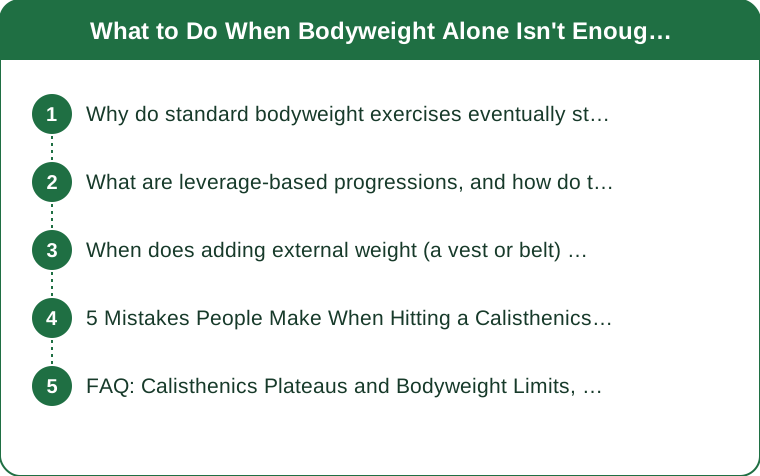
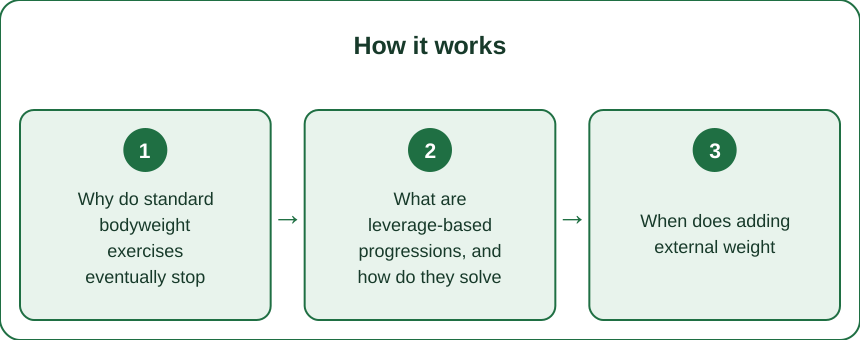
Why do standard bodyweight exercises eventually stop providing enough stimulus?
As relative strength increases, the same bodyweight resistance becomes a smaller percentage of what the muscles are capable of producing, meaning the training stimulus needed for continued adaptation exceeds what standard bodyweight movements alone provide at a certain strength level. This is a normal and expected point in progression, not a sign of doing something wrong.
What are leverage-based progressions, and how do they solve this?
Leverage-based progressions change the exercise’s mechanics — moving one arm or leg further from the body’s center of mass, as in archer pull-ups or pistol squats — which increases the effective resistance without adding external weight, allowing continued progression using bodyweight training principles even after standard variations plateau.

When does adding external weight (a vest or belt) make more sense than a leverage progression?
External loading tends to work well when a leverage progression would be technically very difficult to learn safely, or when a specific, measurable strength number (like a max weighted pull-up) is the actual training goal, making it a complementary tool rather than a replacement for leverage-based bodyweight progression.
5 Mistakes People Make When Hitting a Calisthenics Plateau
1. Assuming a plateau means switching entirely to weightlifting is required. 2. Jumping straight to the hardest leverage variation instead of progressing through intermediate steps. 3. Adding too much external weight too quickly, sacrificing form for load. 4. Neglecting mobility work needed for advanced leverage positions (like full pistol squat depth). 5. Training the same plateaued movement pattern without addressing weak supporting muscles that may be the actual limiting factor.
FAQ: Calisthenics Plateaus and Bodyweight Limits, Answered
How do I know if I’m ready for a leverage progression versus needing more foundational strength first?
Being able to perform the current exercise for high reps (typically 15-20+) with good form is a common benchmark suggesting readiness for the next leverage-based progression.
Is combining leverage progressions and external weight ever a good approach?
Yes — many advanced calisthenics athletes use both together, choosing whichever progression tool fits a specific movement or goal at a given time.
Does a calisthenics plateau ever mean a nutrition or recovery issue rather than a training programming one?
Yes — inadequate recovery, sleep, or protein intake can also cause a training plateau that looks like a bodyweight resistance ceiling but is actually a recovery capacity issue worth ruling out.
TL;DR:
- A bodyweight plateau reflects the exercise’s fixed resistance becoming too small relative to current strength, not a training ceiling
- Leverage-based progressions increase difficulty through mechanics rather than added external weight
- External loading (a vest or belt) complements leverage progressions for specific strength goals
- Recovery and nutrition issues can sometimes mimic a bodyweight resistance plateau and are worth ruling out
A calisthenics plateau is a normal signal to advance to the next progression tier, not a sign that bodyweight training has reached its limit.
Keep Reading
This article is for general informational and styling purposes only. Fit, sizing, and product availability may vary.