Why Your Wrists Hurt in Push-Ups and Planks - and How to Fix It
Quick Answer: Wrist pain in floor work usually means demand has outrun capacity - your wrists spend all day in a neutral typing position, then you suddenly load your bodyweight onto them at ninety degrees of extension. Fix tonight’s session by gripping the floor with your fingertips, angling the hands slightly outward, or elevating your hands. Fix it permanently with ninety seconds of wrist prep before training and gradual loading, because wrists adapt more slowly than the muscles around them.
Your chest could do five more push-ups. Your core could hold the plank another thirty seconds. But your wrists are done, so the set is done. It feels like a defect. It is actually the most predictable bottleneck in bodyweight training - and one of the most fixable.

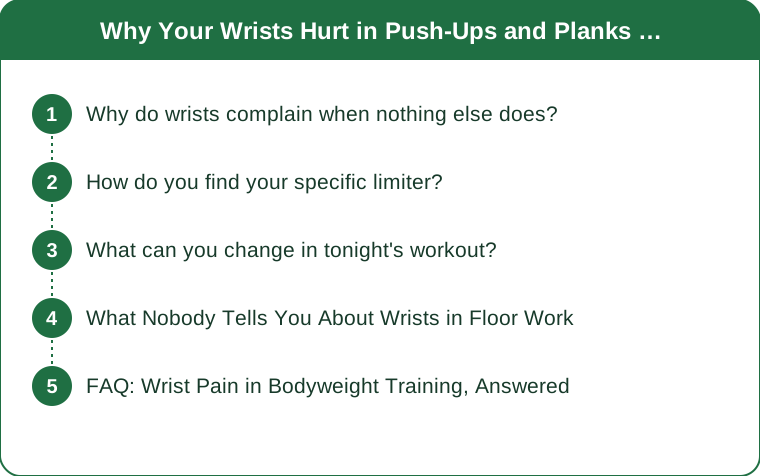
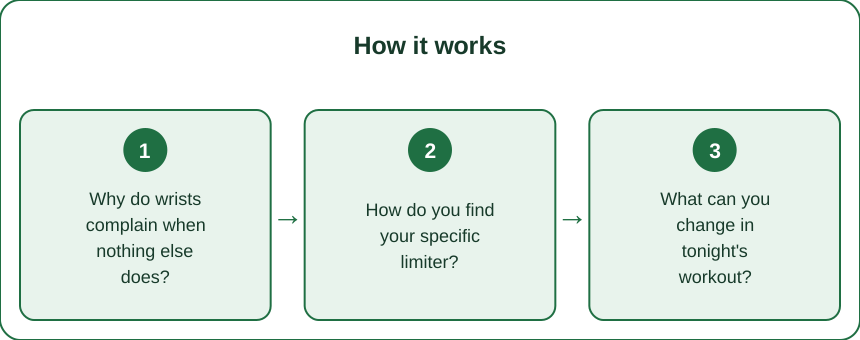
Why do wrists complain when nothing else does?
Because floor work asks the wrist for something modern life never rehearses.
Ninety degrees of extension under load is a rare event. Typing, phone use, cooking, driving - the daily catalog keeps your wrists close to neutral, lightly loaded. A push-up position bends the wrist back to its end range and then parks a large fraction of your bodyweight on it. For most adults, the first plank of a fitness journey is the most extension-under-load their wrists have experienced in years.
The load concentrates in the heel of the palm. When the hand is passive - flat and relaxed - your weight funnels through the base of the palm directly into the small carpal bones and the soft tissue over them. There is not much muscle there to share the work, so the joint structures take it raw.
Capacity builds slower than strength. Your chest and shoulders are big muscles that adapt within weeks. The wrist is a dense parcel of small ligaments, tendons, and cartilage, and connective tissue adapts on a timeline of months. So your push-up count climbs faster than your wrist tolerance does, and the gap between them is exactly what you feel at the end of a set.
The reassuring part: a diffuse ache across the back or base of the wrist during loading, which eases within minutes of finishing, is a capacity signal rather than damage. It is your wrist saying not yet this much - and there are three separate ways to answer it.
How do you find your specific limiter?
Two minutes of self-testing tells you whether your problem is mobility, load distribution, or technique - and each has a different fix.
Test one: the prayer test for mobility. Palms together in front of your chest, elbows lifted, lower your hands until you feel a stretch. If your wrists cannot comfortably reach ninety degrees this way without load, then in a plank they are being forced past their available range - and range forced under bodyweight always complains. Your priority is gentle daily mobility: prayer stretch holds, slow wrist circles, and rocking forward and back on all fours with flat palms, staying just short of pain.
Test two: the knuckle check for load distribution. Get into a plank and look at your hands. Are your fingers pale and passive, with all the pressure sitting in the heel of your palm? A passive hand dumps everything into the joint. An active hand - fingertips pressing down, knuckles of the fingers pushed into the floor, palm slightly clawed as if gripping a ball - recruits the forearm muscles to share the load. For many people this single cue cuts wrist discomfort in half immediately.
Test three: the stacking check for technique. In your plank or push-up, are your shoulders stacked over or very slightly ahead of your wrists? Hands placed too far forward turn your wrist angle sharper and shift load toward end range. Hands directly under shoulders, with your weight fractionally forward, is the strongest geometry.
Most people fail test two. Almost nobody has ever been told their hands are supposed to be doing something.

What can you change in tonight’s workout?
You do not need to stop training while your wrists catch up. You need to reroute the load, and there are five ways, ordered from smallest change to largest.
Turn your hands out slightly. Rotating the hands ten to thirty degrees outward changes which part of the wrist takes the bend, and for many people that alone relocates the pressure off the sore spot.
Grip the floor. The active-hand cue from the self-test: fingertips pressing, palm clawed, knuckles down. Make it a rule that every rep starts with the grip - it also stabilizes your shoulders, which is a free bonus.
Elevate your hands. Push-ups with hands on a bench, a sturdy chair, or a countertop reduce both the load and the wrist angle at once. This is not a regression to be embarrassed about - it is the same exercise with the dial turned to where your wrists currently are.
Change the wrist angle entirely. Fists on a folded mat, hexagonal dumbbells held as handles, or a pair of push-up bars all keep the wrist neutral - the position it is already strong in. Knuckle work on a soft surface feels intense at first but many people with cranky wrists find it removes the problem completely.
Trade duration for sets. Three twenty-second planks with rest stress the wrists far less than one grinding sixty-second hold, while giving your core nearly the same work. Accumulate quality time rather than testing survival time.
Use whichever combination lets you finish sets limited by the muscles you are training rather than the joints you are balancing on.
What Nobody Tells You About Wrists in Floor Work
Wrists respond to warm-up more than almost any joint. Ninety seconds of circles, rocking on all fours, and gentle loaded stretching changes how the whole session feels. Most people warm up everything except the one joint that will fail first.
Desk hands make gym wrists. Eight daily hours of keyboard-neutral position is training - it is just training a tiny range. The rocking drills that fix wrist mobility take under two minutes and work best done daily, not only on workout days.
Location is information. A diffuse ache across the back of the wrist during loading is the ordinary capacity complaint. Pain concentrated on the pinky side, especially with twisting motions like opening jars, or pain with a specific click, is a different pattern - as is any numbness or tingling into the fingers, which points at nerve involvement rather than loading. Persistent night pain, swelling, or symptoms that survive two weeks of sensible modification deserve an actual assessment. This is general information, not medical advice.
The floor surface matters. A soft mat feels kind but lets the heel of your palm sink, sharpening the wrist angle. A firm surface with a thin mat is usually more comfortable for wrists, which surprises everyone who tries it.
Wrist capacity is a quiet superpower. The people who progress to crow pose, handstands, and advanced push-up variations are rarely the strongest - they are the ones whose wrists let them practice. The boring prep you do now is the admission ticket to everything interesting later.
FAQ: Wrist Pain in Bodyweight Training, Answered
Why do my wrists hurt in push-ups but nowhere else?
Push-ups load the wrist at full extension, a position daily life never trains. The ache is usually a capacity gap - the wrist needs more gradual exposure, an active gripping hand, or a neutral-wrist alternative like fists or push-up bars.
Should I stop doing planks if my wrists hurt?
Usually no - modify instead. Elevate your hands, drop to forearm planks for a while, grip the floor actively, and add short daily wrist mobility. Stop and get assessed if pain is sharp, one-sided with clicking, involves numbness, or persists outside workouts.
Do push-up bars actually help wrist pain?
Yes, for most people dramatically. They keep the wrist neutral instead of extended, which is the position your wrists are already conditioned for. Fists on a folded mat achieve the same thing for free.
How long does it take wrists to get stronger?
Expect six to twelve weeks of consistent, gradual exposure before loaded extension feels routine - connective tissue adapts more slowly than muscle. Daily ninety-second mobility work meaningfully shortens the timeline.
TL;DR:
- Wrist pain in floor work is usually a capacity gap, not an injury - daily life never rehearses loaded extension.
- Test yourself: prayer stretch for mobility, knuckle check for load distribution, stacking check for technique.
- Tonight: grip the floor, turn hands slightly out, elevate hands, or go to fists - and split long holds into short sets.
- Ninety seconds of wrist prep daily beats everything else; see someone for sharp, clicking, tingling, or persistent symptoms.
Your wrists are not the weak link. They are the least-trained link - and they respond faster than you expect once you actually train them.
Keep Reading
This article is for general informational and styling purposes only. Fit, sizing, and product availability may vary.