Why Your Plank Shakes But Your Push-Ups Do Not
Quick Answer: Shaking during a plank is normal motor unit behaviour, not weakness. In a static hold your nervous system has to keep the same fibres firing continuously, so it cycles recruitment between motor units and you see that switching as tremor. Push-ups do not shake because the movement gives fibres brief unloading windows on every rep. Shaking becomes a problem only when it starts within 15 seconds, when it is clearly one-sided, or when your hips drop as it begins - those point to position or endurance issues rather than normal fatigue.
It is one of the more confusing things in bodyweight training. You can do a clean set of push-ups. Then you drop into a plank and thirty seconds in you are vibrating like a washing machine on spin.
Same muscles. Same body. Completely different behaviour. And the shake feels like it means something bad.

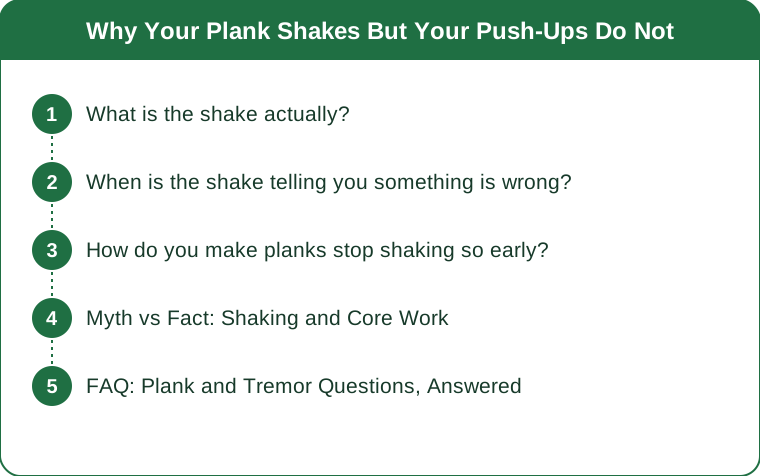
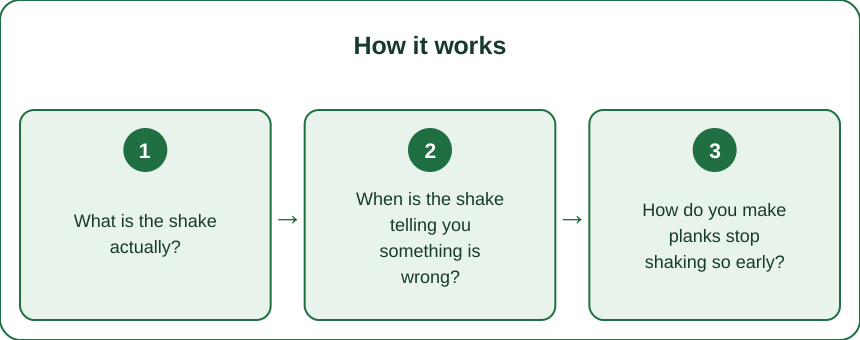
What is the shake actually?
Motor unit cycling. Your nervous system taking turns.
A motor unit is one nerve plus all the muscle fibres it controls. In a dynamic movement like a push-up, your muscles alternate between contracting and lengthening, and each rep gives individual motor units a brief window to unload and recover. Recruitment rotates naturally.
In an isometric hold, nothing rotates on its own. The muscle length does not change, the load never comes off, and your nervous system has to maintain a constant output. To keep that going without exhausting any single set of fibres, it cycles - dropping some motor units and recruiting others in a rolling pattern.
When that cycling is happening quickly and unevenly, you get visible tremor. It is not a failure signal. It is the sound of the machinery working.
There is a second contributor. Isometric contractions restrict blood flow more than dynamic ones. A sustained contraction at moderate intensity compresses the vessels running through the muscle, which limits oxygen delivery and speeds up metabolite accumulation. Push-ups pump; planks squeeze.
And a third: stabilising demand. A plank is a whole-body anti-extension task. Your deep core, hip flexors, quads, shoulders, and even your feet are all working to hold one line. Push-ups have a defined groove - the movement itself organises you. In a plank you are the only thing organising you, and the small constant corrections show up as wobble.
So the honest summary is that shaking in a plank means you are near the working end of an isometric hold, which is exactly where the training effect lives.
When is the shake telling you something is wrong?
Four patterns are worth reacting to.
It starts in the first 15 seconds. Normal fatigue tremor arrives well into a hold. Immediate shaking usually means the position is too hard for your current capacity - or, more often, that your form is loading the wrong tissue. Regress to an incline plank with your hands on a bench and build from there.
It is clearly one-sided. A left-heavy or right-heavy shake points to an asymmetry in stability rather than fatigue. Common causes are one shoulder blade not holding position and one hip sitting lower than the other. Worth filming from the front - most people cannot feel this.
Your hips drop at the same moment the shaking starts. This is the important one. The shake is fine; the sag is not. Once your pelvis tips forward, load transfers from your abdominal wall to your lower back and you are now training a position you do not want. The hold should end at the sag, not continue through it.
It is in your shoulders and neck rather than your trunk. Usually means you are holding yourself up with your upper body rather than bracing through your core - often from placing the elbows too far forward. Elbows should be directly under the shoulders.
One thing that is not a warning sign: shaking that stops as soon as you finish. Tremor that persists for many minutes after, or comes with numbness, is a different conversation and worth raising with a professional.
This is general information, not medical advice.

How do you make planks stop shaking so early?
Fix the position first, then build the specific quality the hold needs.
Position audit, in order of impact:
Elbows under shoulders, not ahead of them. Elbows forward turns the plank into a shoulder endurance test with a core garnish.
Ribs down. Most people hold a plank with the ribcage flared, which switches the work to the lower back. Actively pull the front of your ribs toward your hips - it will feel like a small crunch and it changes the exercise entirely.
Squeeze the glutes and quads. A plank is not a core-only hold. Turning on the glutes tucks the pelvis and removes the sag before it starts. Turning on the quads makes the whole line rigid.
Push the floor away. In a forearm plank, actively press your forearms down and slightly apart. This engages the serratus and stops the shoulder blades winging, which is a common source of upper-body wobble.
Then train it properly:
Short quality holds beat long sloppy ones. Three sets of 20 seconds with a perfect line will build more than one 90-second hold that spends the last 40 seconds sagging. If you can hold a good plank for two minutes, more time is no longer the useful progression - add load or change leverage instead.
Use interrupted sets. 20 seconds on, 10 off, six rounds. This works with the motor unit cycling rather than against it and lets you accumulate more quality time under tension.
Add anti-rotation work. Plank shoulder taps, bird dogs, and dead bugs train the same stabilising job with a moving demand, and they transfer well.
Progress by leverage, not duration. Long-lever planks with hands further forward, feet-elevated planks, and single-arm holds all raise the demand without extending a hold you have already mastered.
Myth vs Fact: Shaking and Core Work
Myth: Shaking means you are building more strength. Fact: Shaking means motor units are cycling under sustained load. It correlates with being near your working limit, but it is not itself the training stimulus and chasing it is not a strategy.
Myth: If you shake, you should stop immediately. Fact: Shaking with a maintained line is fine to hold briefly. The stop signal is the position breaking - hips dropping or ribs flaring - not the tremor.
Myth: A stronger person will not shake. Fact: Strong people shake too, just later and at harder variations. The tremor tracks how close you are to your limit, not how high the limit is.
Myth: Longer planks mean a stronger core. Fact: Beyond about two minutes, plank duration mostly measures your tolerance for discomfort. Elite gymnasts do not train five-minute planks; they train harder variations for shorter holds.
Myth: The shaking is dehydration or low electrolytes. Fact: Very occasionally, but if it only happens during isometric holds and never otherwise, it is mechanical, not nutritional. Genuine electrolyte issues do not politely restrict themselves to planks.
FAQ: Plank and Tremor Questions, Answered
Why do I shake more on some days than others?
Sleep, prior training, caffeine, and how recently you ate all shift motor unit behaviour. Caffeine in particular increases physiological tremor, so a plank straight after a strong coffee genuinely shakes more. Day-to-day variation of 20 to 30 percent in hold time is normal.
Should I hold until failure?
No, and especially not for planks. Hold until the position degrades, then stop and rest. Training past the point where the line breaks reinforces the sagging pattern, which is the opposite of what you want.
Why do side planks shake so much more?
Smaller base of support and a much bigger anti-lateral-flexion demand on a narrower set of muscles. Side planks shaking earlier than front planks is completely normal - compare them to themselves over time, not to each other.
My push-ups are smooth but I fail planks quickly. Is my core weak?
Not necessarily. It usually means your strength is fine but your isometric endurance and bracing skill are undertrained, which is a specific and very trainable gap. Short repeated holds three times a week will close it within a few weeks.
TL;DR:
- Plank tremor is motor unit cycling - your nervous system taking turns to sustain a constant output.
- Push-ups do not shake because each rep gives fibres a brief unloading window. Isometric holds do not.
- The stop signal is the hips dropping or ribs flaring, not the shake itself.
- Shaking in the first 15 seconds, one-sided shaking, or shoulder-dominant shaking all point to position problems.
- Fix elbows under shoulders, ribs down, glutes and quads on, forearms pressing into the floor.
- Past about two minutes, add leverage rather than duration. Long planks stop being a strength exercise.
The shake is not a verdict on your core. It is the most visible evidence you will ever get that your nervous system is doing something clever, and it happens to arrive at the exact moment it feels like failure.
Keep Reading
This article is for general informational and styling purposes only. Fit, sizing, and product availability may vary.