Why Your Left Side Is Weaker in Every Single Bodyweight Move
Quick Answer: Bilateral moves like push-ups and pull-ups let the dominant side quietly do more of the work, so an imbalance never gets exposed or corrected. Test each side separately, then train the weak side first and match the strong side to whatever it can do - not the other way round. Expect eight to twelve weeks for a meaningful change.
You notice it in a plank that drifts, or a push-up where one elbow flares and the other does not, or a pull-up where you end up slightly sideways at the top. It is not your imagination and it is not a defect. It is what happens when you only ever train both sides at once.

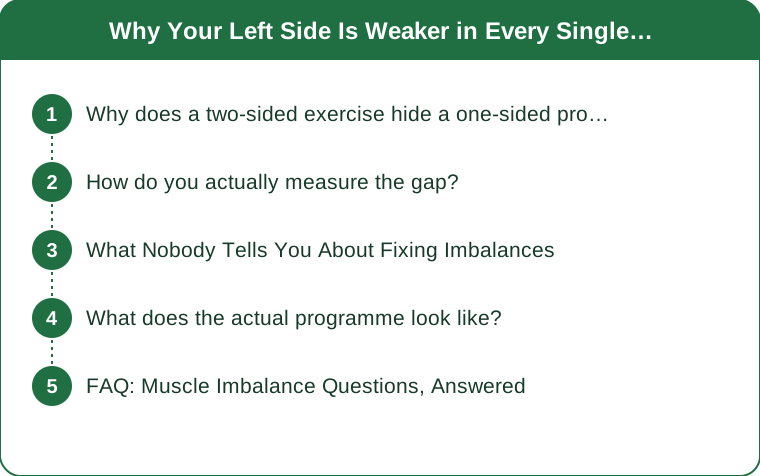
Why does a two-sided exercise hide a one-sided problem?
Because your nervous system is optimising for completing the rep, not for distributing the work fairly.
When you press up from the floor, the total force required is fixed. If the right side can produce more of it, it will, and the rep still happens. Force plate studies on bilateral movements consistently show meaningful asymmetries in load distribution that the person performing them cannot feel. You are not capable of detecting a 15 percent difference in effort between your two arms while both are working.
Three things compound it:
- Handedness. Decades of everyday one-sided use - writing, carrying, opening things - produce genuine differences in strength and, more importantly, in motor control.
- Structural asymmetry. Small differences in rib position, shoulder blade resting position, and hip height change the leverage available on each side.
- Old injuries. A wrist sprain from four years ago that you have forgotten about can still be producing a protective pattern.
The result is a slow divergence. The strong side takes slightly more of every rep, gets slightly more stimulus, and grows slightly stronger, which lets it take slightly more of the next rep. Left alone, that gap widens rather than closing.
And it shows up as a plateau, not as pain. Your push-up count stalls at the same number for months, and the reason is that the weak side has hit its ceiling while the strong side is nowhere near its own.
How do you actually measure the gap?
You cannot see it in a bilateral movement, so you have to break the movement apart. Four tests, done fresh, with full rest between sides.
1. Single-arm plank hold. In a forearm plank, lift one arm and hold it out in front. Time how long you can keep the hips level. Do the other side after two minutes of rest. This exposes the shoulder stabilisers and the anti-rotation core, which is where most bodyweight imbalance lives.
2. Bodyweight row with one arm assisted. Set up a low bar or use suspension straps, and perform rows pulling primarily with one arm while the other rests lightly on the strap for balance only. Count clean reps each side.
3. Single-leg glute bridge. 3 sets of maximum controlled reps, each side. Hips must reach the same height each rep - stop when they do not.
4. Pistol squat progression depth. Sit back toward a bench on one leg and note the lowest height you can control on each side. Use a stack of books or a box you can adjust in small increments.
How to read the results: a difference of up to about 10 percent between sides is normal and not worth chasing. Ten to 20 percent is worth addressing. More than 20 percent, or a difference that comes with pain, is worth a conversation with a physio rather than a self-designed programme. This is general information, not medical advice.
Write the numbers down. You will not remember them in six weeks, and the whole point is to be able to retest.

What Nobody Tells You About Fixing Imbalances
It is usually motor control, not muscle size. The weak side is often not much smaller - it is worse at recruiting what it has. That is good news, because control improves faster than muscle does. Some of the gap closes in three to four weeks purely from practice.
Doing extra sets on the weak side alone rarely works. The standard advice is to add sets for the lagging side. In practice, if you train both sides and then add extra for the weak one, the strong side keeps its head start and you are chasing a moving target.
The approach that works is matching down. Train the weak side first, take it to a hard but clean set, then perform the same number of reps on the strong side - even if the strong side could do more. Your strong side stops progressing for a while. That is uncomfortable and it is the entire mechanism.
Unilateral work also improves bilateral performance. There is a well-documented cross-education effect where training one limb produces measurable strength gains in the untrained limb, mediated by the nervous system. Training the weak side does not only help the weak side.
The imbalance will come back if you stop. Your daily habits are what created it. Carrying a bag on one shoulder, always taking the stairs leading with the same foot, sleeping on one side. Once you have closed the gap, keep one unilateral movement in your weekly routine permanently as maintenance.
And you will feel worse before you feel better. Training the weak side to its actual limit is unpleasant in a way that bilateral training is not, because there is nowhere for the effort to go.
What does the actual programme look like?
Eight to twelve weeks, two dedicated sessions per week, added to what you already do rather than replacing it.
Session structure - four movements, weak side always first:
- Single-arm plank - 3 holds each side, stopping when the hips shift. Weak side sets the time.
- Archer push-ups or elevated one-arm-emphasis push-ups - 3 sets of 5 to 8 each side. Elevate the hands on a bench or counter until you can control the movement.
- Single-leg glute bridge or single-leg hip thrust - 3 sets of 8 to 12 each side.
- Split squat or Bulgarian split squat - 3 sets of 6 to 10 each side, going only as deep as the weak side can control.
Progression rule: add reps to the weak side first. When the weak side has gained two reps on a movement, retest that movement on both sides. When the gap is under 10 percent, you can go back to matching reps normally.
Do not drop bilateral training entirely. Keep your regular push-ups and pull-ups, but reduce the volume slightly so recovery holds. You are adding one-sided work, not doubling your total.
Fix the daily habits at the same time. Switch the bag shoulder. Alternate which foot leads on stairs and which arm reaches for things above shoulder height. These sound trivial and they are the input that has been running eighteen hours a day for years, against your four sessions a week.
Retest at week 6 and week 12. Progress on imbalances is slow and mostly invisible day to day, and without numbers written down you will conclude nothing is happening about three weeks before something does.
FAQ: Muscle Imbalance Questions, Answered
Is it normal for one side to be weaker?
Yes. A difference of up to roughly 10 percent between sides is common and does not need fixing. It becomes worth addressing when it is larger than that, or when it stops your bilateral movements from progressing.
How long does it take to fix a muscle imbalance?
Usually eight to twelve weeks of consistent unilateral work for a meaningful change. Some improvement in control appears within three to four weeks, but strength changes lag behind.
Should I do extra sets on my weak side?
Matching down works better than adding on. Train the weak side first, then do the same number of reps on the strong side even if it could do more. Extra sets alone tend to leave the head start intact.
TL;DR:
- Bilateral moves hide asymmetry because the strong side silently takes more of every rep.
- Test each side separately - plank hold, single-arm row, single-leg bridge, pistol depth - and write the numbers down.
- Train the weak side first and match the strong side down to it, rather than adding extra sets.
- Fix the daily one-sided habits too; they run far more hours than your training does.
The stall in your push-up numbers is usually not your chest. It is one shoulder that ran out of road while the other one was still coasting.
Keep Reading
This article is for general informational and styling purposes only. Fit, sizing, and product availability may vary.