Why Your First Pull-Up Needs Eccentrics, Not More Attempts
Quick Answer: You cannot train a movement by repeatedly failing at it, because failed attempts provide almost no time under tension. Eccentric pull-ups - jumping to the top and lowering as slowly as possible - work because you are roughly 20 to 50% stronger lowering a load than lifting it, so you can produce genuine training stimulus at a strength level where the concentric is still impossible. Three to five slow negatives, twice a week, is the fastest documented route to a first pull-up for most people.
You have been jumping at that bar for six weeks. It has not moved.

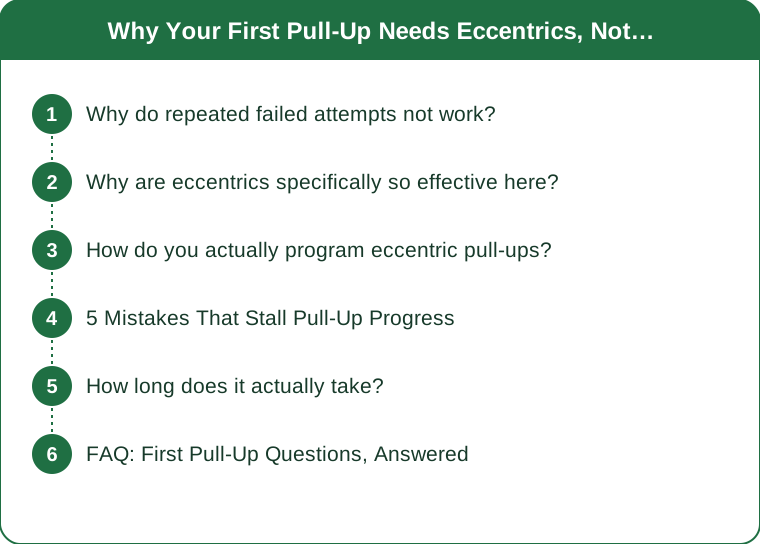
Why do repeated failed attempts not work?
Because training adaptation responds to accumulated tension over time, and a failed attempt provides almost none of it.
Think about what actually happens in a failed pull-up. You pull hard for one or two seconds, rise a few inches, stall, and drop. Total time under meaningful tension: perhaps two seconds. Ten failed attempts gives you twenty seconds of scattered effort, mostly at a joint angle where you are already strongest.
Compare a single 20-second eccentric. One repetition, twenty seconds of high tension, through the full range of motion including the positions where you are weakest.
The comparison is not close, and the eccentric version also loads the range you actually need to develop.
There is a second problem with repeated failure: you are practising the neural pattern of stalling. Motor learning does not distinguish between the movement you want and the movement you perform - repeatedly rehearsing an incomplete pull with a stall at the same point reinforces exactly that.
And a third, which matters most in practice: it is demoralising, and adherence is the actual limiting factor for most people. Six weeks of visible progress in negatives beats six weeks of identical failure, regardless of the physiology.
Why are eccentrics specifically so effective here?
Three mechanisms stack, and the first one is the reason this works at all.
1. You are substantially stronger eccentrically than concentrically. The commonly cited figure is roughly 20 to 50% greater force capacity in the lowering phase than in the lifting phase. This is the entire basis of the method - it means there is a window where you can control a load you cannot lift, and that window is exactly where a pre-pull-up trainee lives.
2. Eccentric loading produces strong adaptation stimulus. Controlled lengthening under load is a well-established driver of both strength and hypertrophy, and it produces high tension per unit of effort.
3. It trains the full range, including the bottom. Most people’s sticking point is the dead-hang start, and that is precisely the position that failed jumping attempts never load properly. Lowering all the way to a straight-arm hang loads it under control every single rep.
The trade-off worth knowing: eccentric-heavy training produces more delayed onset muscle soreness than concentric work, particularly in the first few weeks. That is expected, and it is why frequency should stay moderate - two sessions a week, not five.
How do you actually program eccentric pull-ups?
A concrete protocol, and the progression that follows it.
The basic execution:
- Get to the top position. Jump from the floor, step off a box, or use a chair. Chin over the bar, chest close to it.
- Hold the top for a second. Shoulders down and back, not shrugged to your ears.
- Lower as slowly as you can control. Target 5 seconds at first, building toward 10 or more.
- Finish in a full dead hang with straight arms - do not drop off at the halfway point.
- Rest 90 seconds to 2 minutes. These are strength reps, not conditioning.
The starting protocol: 3 sets of 3 reps, 2 sessions per week, 5-second lowers. That is the whole thing.
Progression, in this order:
- Extend the lower from 5 seconds toward 10
- Add reps - 3x3 becomes 3x5
- Add a pause at the halfway point for 2 to 3 seconds
- Test the concentric every 2 to 3 weeks - do not test every session
The rule for testing: when you can control a 10-second lower for 5 reps, you are usually close. Test on a fresh day, first thing in the session, not at the end of a workout.
What to pair it with: eccentrics alone are effective, and they are better with support work. Inverted rows are the single best partner exercise - they train the same pattern concentrically at a load you can actually lift, and you can adjust difficulty by changing your body angle. Two sets of 8-12, twice a week.

5 Mistakes That Stall Pull-Up Progress
Mistake 1: Dropping instead of lowering. The most common execution error. If the descent takes under 3 seconds, you are falling with your hands on a bar, and you are getting almost none of the benefit. Slow is the entire mechanism.
Mistake 2: Stopping the descent at 90 degrees. The bottom third is where you are weakest and where the training is most needed. Lower all the way to straight arms every rep, even when it gets ugly.
Mistake 3: Relying only on assisted-machine pull-ups. The assisted machine removes load from the bottom range disproportionately and it does not teach you to control your own bodyweight. It is not useless, and it is a poorer tool than eccentrics or bands for this specific goal.
Mistake 4: Training pull-ups four or five times a week. Eccentric work is demanding and pulling muscles need recovery. Two quality sessions produce better results than five fatigued ones, and the frequency error is the most common reason people plateau while working hard.
Mistake 5: Ignoring the scapula entirely. A pull-up starts with the shoulder blades - depressing and retracting them - before the arms bend. People who cannot do this initiate with the biceps and stall immediately. Scapular pulls, which are hanging from the bar and pulling your shoulder blades down without bending your arms, fix it. Three sets of 5, before your eccentrics.
### Myth vs Fact: Pull-Up Training
Myth: Women cannot do pull-ups. Fact: Trained women do pull-ups routinely. The differences in average upper body mass distribution mean the starting point is often further back, and the training response is the same. The persistence of this myth costs more first pull-ups than any physiological factor.
Myth: You need to lose weight first. Fact: Relative strength is what matters, and strength training improves it directly. Waiting to be lighter before training the movement delays the training that would have got you there.
Myth: Lat pulldowns will get you there. Fact: They help and they transfer imperfectly, because the stability demands and the loading pattern differ. Pulldowns are a supplement to bodyweight work, not a substitute for it.
Myth: Bands are cheating. Fact: Bands are a legitimate tool with one caveat - they assist most at the bottom, which is where you need the most work. That makes them useful for volume and inferior to eccentrics for building the weak range.
How long does it actually take?
Honest ranges, because unrealistic expectations account for a large share of abandonment.
If you can already hold a dead hang for 30 seconds and do inverted rows at a low angle: commonly 6 to 12 weeks of consistent twice-weekly work.
If you can hang but not row well: 3 to 6 months is a realistic range.
If you cannot yet hold a dead hang for 20 seconds: start with hangs and rows, and expect 6 months or more. This is a completely normal starting point and it is not a reason not to start.
What speeds it up:
- Consistency above everything - two sessions a week, every week, beats sporadic hard training
- Progressive overload in lower duration and rep count
- Adequate protein and sleep, which are the boring answers and remain true
- Direct grip work, since grip is the limiting factor for more people than expect it
What slows it down:
- Testing your max attempt every session, which produces fatigue without stimulus
- Skipping the bottom range
- Training to failure repeatedly on eccentrics
- Long gaps between sessions
A useful marker along the way: the first time you feel yourself genuinely controlling the bottom third of the descent rather than surviving it. That usually happens a few weeks before the first full pull-up, and it is the best predictor that it is coming.
FAQ: First Pull-Up Questions, Answered
How many eccentrics should I do per session?
Start with 3 sets of 3. Nine quality slow reps is plenty. Volume beyond that mostly produces soreness rather than faster progress.
Should my grip be overhand or underhand?
Train the one you want first. Underhand chin-ups are easier for most people because they recruit the biceps more, so they are a reasonable first target - overhand pull-ups then follow more quickly.
My forearms give out before my back. What do I do?
Add dead hangs at the end of your sessions and consider chalk. Grip is the hidden limiter for a lot of people and it responds quickly to direct work.
Is it normal to be very sore after eccentric training?
Yes, particularly in the first few weeks - eccentric work produces more soreness than concentric work. It should reduce substantially as you adapt. Sharp joint pain, particularly at the elbow or shoulder, is different and warrants backing off and getting it assessed.
Can I do this with no pull-up bar?
A doorway bar is the cheapest solution. Failing that, inverted rows under a sturdy table build the same pattern and will get you a long way before a bar becomes necessary.
TL;DR:
- Failed attempts give you about two seconds of tension; one slow negative gives you twenty
- You are 20 to 50% stronger lowering than lifting, which is the window eccentrics exploit
- 3 sets of 3, twice a week, lowering 5 to 10 seconds, all the way to straight arms
- Pair with inverted rows and scapular pulls; test your max every two to three weeks, not daily
- Six weeks to six months depending on starting point - consistency beats intensity throughout
Stop jumping at the bar. Start lowering from it.
Keep Reading
This article is for general informational and styling purposes only. Fit, sizing, and product availability may vary.