One Bench, Whole Workout: The Park Bench Circuit
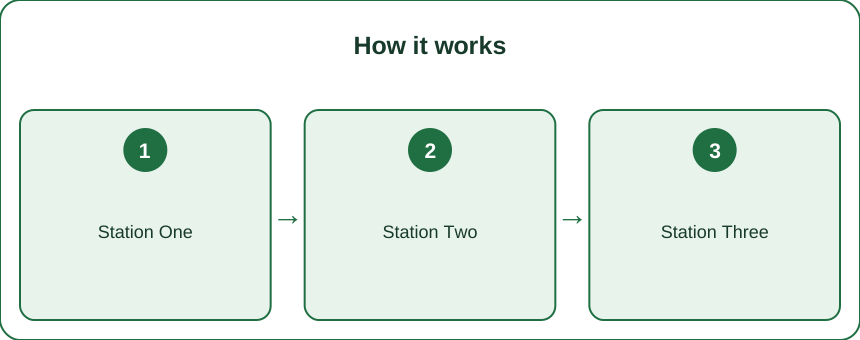
Quick Answer: A park bench is enough equipment for a full-body workout — step-ups for legs, incline pushups for chest and arms, dips for triceps, and Bulgarian split squats for single-leg strength. Run the four stations for three rounds and you’ve covered legs, chest, arms, and balance in about twenty minutes with zero membership required.
Every park bench lives a double life: mostly pigeon lounge, occasionally a legitimate four-station gym for anyone who bothers to look at it that way. One bench, four exercises, twenty minutes, and no membership fee gets you a workout that covers legs, chest, arms, and your evolving relationship with Bulgarian split squats.

Can you really build a full workout using just a bench?
Yes — a bench gives you four distinct exercise categories if you know where to look: a step-up platform, an incline pushing surface, a dip support, and an elevated rear-foot anchor for split squats. That’s legs, chest, triceps, and unilateral leg strength, all from one static object.
The trick is treating the bench like actual equipment instead of a place to sit between sets. Angle and hand or foot placement change the difficulty of nearly every move, which means the same bench scales from a beginner session to a genuinely tough one just by adjusting where your hands or feet land.
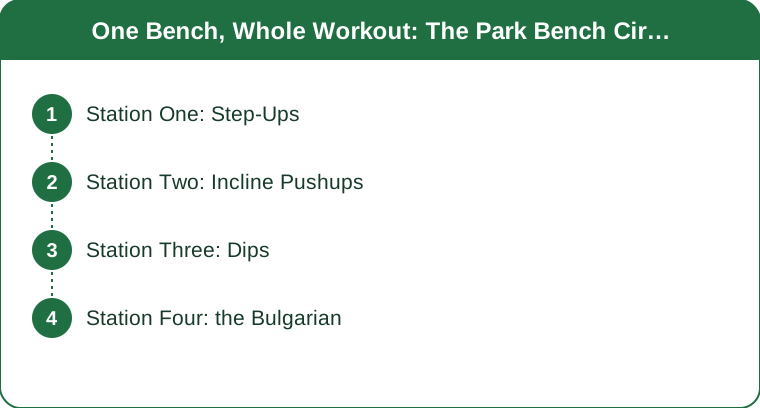
Station one — how do you do step-ups correctly?
Get your full foot on the bench, not just your toes, and drive through the heel on the way up rather than pushing off with your bottom leg. Twelve reps per leg, controlled on the way down — the eccentric portion is where a lot of the actual muscle work happens.
Resist the temptation to bounce off the ground leg for momentum. If the bottom leg is doing meaningful work to launch you upward, the top leg isn’t getting the full stimulus, and the bench, frankly, notices the cheating even if nobody else does.
Station two — what’s the right way to do incline pushups on a bench?
Place your hands on the backrest or the seat — higher hand placement means an easier pushup, so start on the backrest if you’re newer to pushups and work down to the seat as you get stronger. Keep your body in a straight line from head to heel and bring your chest to the edge on every rep.
This is the adjustable-difficulty version of a pushup: seat-height today, ground-level someday, with a pigeon audience the entire time. There’s no shame in starting high — an incline pushup with good form builds more useful strength than a floor pushup done with a sagging hip.
Station three — how do you do bench dips without wrecking your shoulders?
Hands on the seat edge, hips close to the bench, elbows tracking straight back rather than flaring out to the sides. Start shallow before going deep — a partial-range dip with clean elbow tracking beats a full-depth dip that turns your shoulders into the limiting factor.
Your triceps will introduce themselves by name the next morning. If your shoulders start complaining during the set, that’s your body telling you to shallow the range, not push through — dips are a move you earn gradually, and shoulder joints are less forgiving than most other joints when it comes to pushing past discomfort.
Station four — what makes the Bulgarian split squat so effective?
Rear foot up on the seat, front leg doing essentially all the work through a deep lunge pattern. Ten reps per side of pure, honest single-leg difficulty — no fancy equipment brand required, just a bench, some balance, and a willingness to wobble in public for a few reps.
Single-leg work like this exposes strength imbalances between your left and right sides that bilateral exercises like regular squats tend to hide. It’s uncomfortable in a very specific, humbling way the first few times, and that discomfort is usually a sign it’s doing exactly what it’s supposed to.
5 Mistakes Everyone Makes on the Park Bench Circuit
- Skipping the warm-up because it’s “just bodyweight.” Bodyweight moves still load joints — a few minutes of leg swings and arm circles goes a long way.
- Letting the back knee slam the ground on Bulgarian split squats. Control the depth instead of dropping into it; a light tap is enough.
- Flaring elbows out on dips. It’s harder on the shoulder joint than tracking them back, and it’s the fastest way to end a session early.
- Choosing a wobbly or unstable bench. Test it with your hand first — a bench that rocks turns a strength exercise into a balance hazard.
- Rushing through all four stations without rest. A short breather between stations keeps form clean, and clean form is where the actual results come from.
FAQ: Park Bench Workouts
What muscles does a park bench workout actually train?
The four-station circuit covers quads and glutes through step-ups and split squats, chest and shoulders through incline pushups, and triceps through dips — close to a full-body session using one piece of stationary equipment.
How many rounds of the park bench circuit should you do?
Three rounds of all four stations is a solid standard session, taking roughly 20 minutes depending on rest between exercises. Beginners can start with two rounds and build up as step-ups, pushups, dips, and split squats all get more comfortable.
Is a park bench workout safe for beginners?
Yes, with a few adjustments — start incline pushups higher on the backrest, keep dips shallow, and go slower on step-ups and split squats until your balance improves. If you have a shoulder or knee issue, check with a doctor or trainer before adding dips or deep split squats specifically.
TL;DR:
- A single park bench supports four exercises: step-ups, incline pushups, dips, and Bulgarian split squats.
- Full foot on the bench and driving through the heel is the key form cue for step-ups.
- Hand placement on incline pushups controls difficulty — higher is easier, lower toward the seat is harder.
- Keep dips shallow at first and track elbows back, not out, to protect your shoulders.
- Three rounds of all four stations covers legs, chest, arms, and single-leg balance in about 20 minutes.
Keep Reading
This article is for general informational and styling purposes only. Fit, sizing, and product availability may vary.