How to Build to a Dip When You Have No Parallel Bars
Quick Answer: You can reach a full dip with two sturdy chairs, a kitchen counter corner, or the edge of a bench. The progression is bench dips with feet close, then feet extended, then elevated feet, then straight-bar or counter-edge dips with partial bodyweight, then the real thing. Most people who train it twice a week get their first clean dip in 8 to 12 weeks.
Pull-ups get all the attention in bodyweight training, which leaves a big hole on the pushing side. A dip loads the chest, front delts, and triceps through a longer range than any push-up variation - and the equipment problem is mostly imaginary.

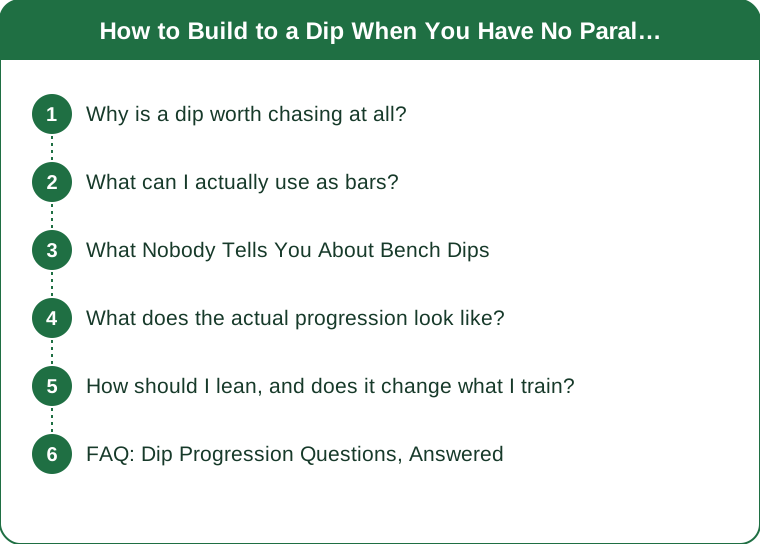
Why is a dip worth chasing at all?
Push-ups plateau. Once you can do 20 clean reps, adding more reps trains endurance rather than strength, and the standard fixes - feet elevated, hands narrow - only add so much.
A dip changes the loading entirely. You move roughly 90 to 95 percent of bodyweight instead of the 60 to 70 percent a standard push-up moves, and you do it through a deeper shoulder extension range. That combination is why dips are sometimes called the upper body squat.
There is also a practical carryover argument. Getting out of a pool, pushing up off the ground, lifting yourself over a wall - all of them are dip patterns. Push-ups do not train that at all.
What can I actually use as bars?
More than you think. In rough order of how well they work:
- Two sturdy dining chairs, seats facing each other, backs outward. Test them with your full weight before you leave the ground.
- A kitchen counter corner where two runs of counter meet at 90 degrees. Excellent height and completely solid.
- A bench, low wall, or coffee table edge for the early bench-dip phases.
- Playground equipment. Most parks have low parallel rails intended for balance work that are perfect dip height.
- A stair rail or sturdy desk edge for straight-bar dips, which are a legitimate variation, not a downgrade.
Stability matters more than height. A wobbling chair recruits every stabilizer you have and teaches you to keep the range short, which is the opposite of what you want.
What Nobody Tells You About Bench Dips
Bench dips get recommended as the beginner version, and they are - but they come with a catch that nobody mentions.
In a bench dip, your hands are behind your torso and your shoulders sit in internal rotation plus extension at the bottom. That is the position most associated with anterior shoulder discomfort. It is fine in small doses and shallow ranges. It is not fine as a place to live for three months chasing rep counts.
So use bench dips as a short on-ramp, not a home. Two to three weeks, staying above the point where your shoulders start to roll forward, then move to a variation where your hands are beside your torso - chairs, counter corner, or a straight bar.
A useful cue: stop the descent when your upper arm reaches parallel with the floor. Going deeper on a bench does not build more strength, it just accumulates shoulder stress.

What does the actual progression look like?
Four phases, roughly 2 to 4 weeks each depending on where you start.
Phase 1 - Bench dips, feet under knees. 3 sets of 8 to 12, controlled 3-second lowering. Stop at upper arms parallel.
Phase 2 - Chair or counter dips, feet on the floor taking partial weight. Straighten your legs out in front and let your heels carry maybe 30 percent of you. 3 sets of 6 to 10. This is the phase most people rush.
Phase 3 - Negatives. Jump or step to the top position with arms locked, then lower as slowly as you can - aim for 5 seconds. 4 sets of 3. Negatives build strength in the exact position that is currently failing.
Phase 4 - Full dips, partial range, growing. 3 sets of 3 to 5, adding depth week by week rather than adding reps.
Train it twice a week with at least 48 hours between sessions. The triceps and front delts recover fast, but the sternoclavicular and shoulder joint structures do not appreciate daily loading in a new range.
How should I lean, and does it change what I train?
It changes a lot. Torso upright, elbows tucked close to your ribs shifts the emphasis toward triceps. Torso leaning forward 20 to 30 degrees, elbows flaring slightly shifts it toward the chest.
For a first dip, the forward lean version is usually easier because it recruits the larger chest muscles. Once you can do 5 of those, add upright reps as a separate exercise rather than switching over.
One consistent form error: shrugging. If your shoulders climb toward your ears at the bottom, you are losing scapular depression and putting load into tissue that should not be carrying it. Cue pull your shoulders away from your ears and hold that the entire rep. Practice it in a static hold at the top for 20 seconds before you ever lower.
FAQ: Dip Progression Questions, Answered
How deep should I go?
Upper arm parallel to the floor is the standard target. Going below that adds shoulder stress with limited strength return for most people. If you have a history of shoulder issues, stop above parallel and add reps instead.
Can I do dips if my shoulders click?
Painless clicking is common and usually not a problem. Clicking with pain, or clicking that appeared alongside a drop in strength, is worth a physio conversation before you load it. This is general information, not medical advice.
How many weeks to a first full dip?
With twice-weekly training from a base of about 15 solid push-ups, 8 to 12 weeks is typical. Starting from fewer push-ups, build those to 12 to 15 first - it shortens the whole timeline.
TL;DR:
- A dip loads 90 to 95 percent of bodyweight versus roughly 65 percent for a push-up, which is why push-ups plateau and dips do not.
- Two chairs, a counter corner, or a park rail are all you need.
- Use bench dips as a 2 to 3 week on-ramp only - the hands-behind-torso position is not somewhere to live.
- Progress through partial-weight dips, then slow negatives, then partial-range full dips.
- Forward lean targets chest, upright targets triceps. Keep shoulders pulled down away from your ears throughout.
If you have been stuck at the same push-up number for months, this is the unlock. Two sessions a week and a sturdy chair is the entire equipment list.
Keep Reading
This article is for general informational and styling purposes only. Fit, sizing, and product availability may vary.