Using Resistance Bands to Bridge the Gap When Bodyweight Alone Isn't Enough
Quick Answer: Resistance bands are most useful in calisthenics for bridging the specific strength gap between two bodyweight progressions — like assisted pull-ups before a first unassisted rep — by providing adjustable, reducible assistance that a bodyweight-only approach can’t offer in fine enough increments.
Calisthenics plateaus have a specific, frustrating shape: you can do the easier progression comfortably, but the next one up feels like an impossible jump with nothing in between. Resistance bands exist specifically to fill that gap.

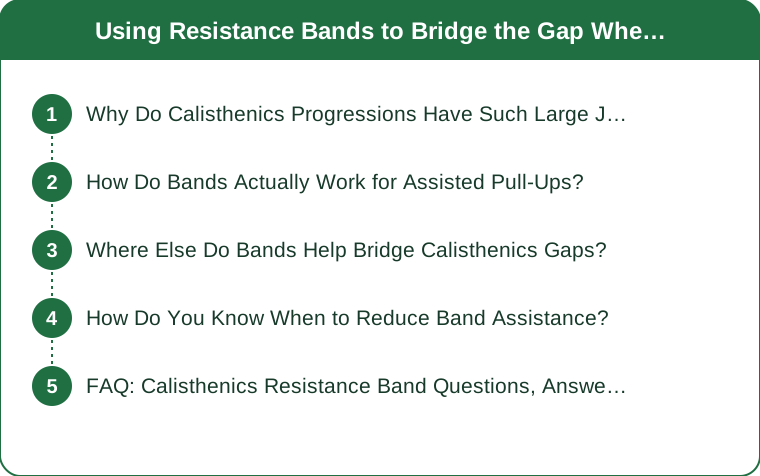
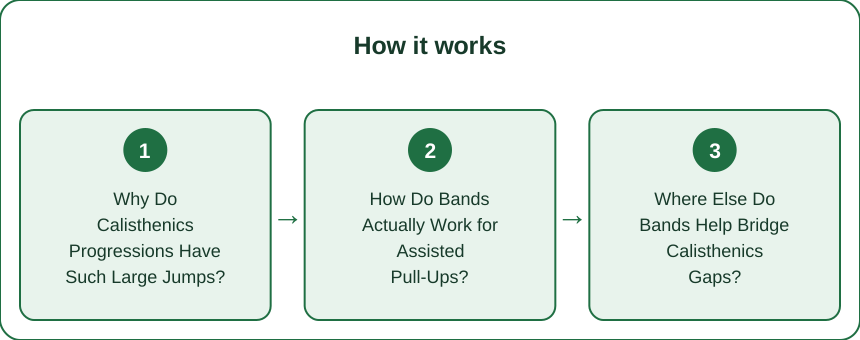
Why Do Calisthenics Progressions Have Such Large Jumps?
Bodyweight progressions often move in fairly large strength increments — from a supported row to a full pull-up, for instance — because there isn’t an easy way to fine-tune resistance the way adding a small weight plate would in traditional strength training. This is a structural limitation of bodyweight-only training, not a personal weakness.
Resistance bands solve this by providing assistance that can be reduced in small, gradual increments (using thinner bands or looping differently) as strength improves, effectively creating the missing intermediate steps that bodyweight progressions alone don’t offer.
How Do Bands Actually Work for Assisted Pull-Ups?
A band looped over the pull-up bar and under one knee or foot provides upward assistance through the hardest part of the pull-up range, reducing the effective weight you’re lifting without changing the movement pattern itself. As strength improves, switching to a thinner band provides less assistance, creating a gradual, controllable progression toward an unassisted rep.
This differs meaningfully from other assisted pull-up methods, like a machine that reduces bodyweight proportionally throughout the entire range — bands actually provide more assistance at the bottom (hardest part) and less at the top, which somewhat mismatches natural strength curves but still provides a workable bridge for most people.

Where Else Do Bands Help Bridge Calisthenics Gaps?
Beyond pull-ups, bands assist effectively with dips (looped under the knees or feet for support), pistol squats (holding a band anchored at an angle for balance and partial assistance), and handstand progressions (providing a small counterbalance during wall-supported practice).
The common thread across all these applications is the same: bands provide adjustable assistance precisely at the hardest point of a movement, letting you practice the full range of motion with support rather than avoiding the movement entirely until you’re strong enough to attempt it unassisted.
How Do You Know When to Reduce Band Assistance?
A reasonable guideline: once you can complete your target rep range (for example, 3 sets of 5) with noticeably less than maximum effort using your current band, it’s time to progress to a thinner band or reduce assistance further, rather than staying at a comfortable assistance level indefinitely.
Progress can feel slow using this method compared to other strength training, and that’s expected — many people report needing several weeks at each band thickness before an unassisted rep becomes achievable, particularly for pull-ups specifically, which recruit a demanding combination of back, arm, and grip strength.
FAQ: Calisthenics Resistance Band Questions, Answered
Do resistance bands actually help build toward a first unassisted pull-up?
Yes — they provide adjustable, reducible assistance that creates gradual intermediate steps between bodyweight progressions that otherwise jump in large increments.
How do I know which band thickness to start with?
Start with a thicker band that lets you complete your target reps with noticeable but manageable effort, then progress to thinner bands as that becomes too easy.
Are bands better than other assisted pull-up methods like machines?
Neither is strictly better — bands provide more assistance at the bottom of the movement and less at the top, which differs from machine-assisted methods, but both are workable bridges toward an unassisted rep.
TL;DR:
- Bodyweight progressions often jump in large strength increments with no bridge between steps
- Resistance bands provide adjustable, reducible assistance that fills exactly that gap
- They help with pull-ups, dips, pistol squats, and handstand progressions alike
- Progress to a thinner band once your target reps feel noticeably less than maximal effort
If a specific calisthenics progression has felt stuck for weeks, a resistance band might be the missing intermediate step rather than a sign you need to train harder.
Keep Reading
This article is for general informational and styling purposes only. Fit, sizing, and product availability may vary.