What to Actually Do on Calisthenics Recovery Days (Besides Nothing)
Quick Answer: Light mobility work, an easy walk, gentle stretching focused on muscles worked recently, and adequate hydration and protein intake are the most useful recovery-day activities for calisthenics training — full inactivity isn’t necessary, and light movement often speeds recovery more than complete rest.
A recovery day isn’t a day off from thinking about training entirely — it’s a day of intentionally lighter, different activity that actually supports the work you did in your last session.

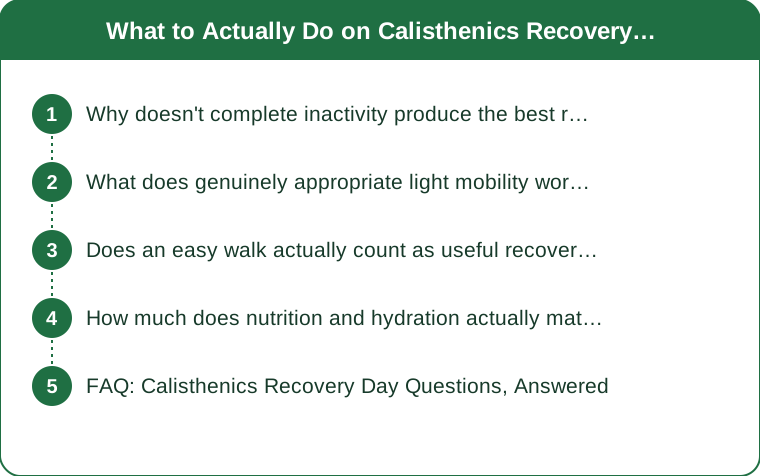
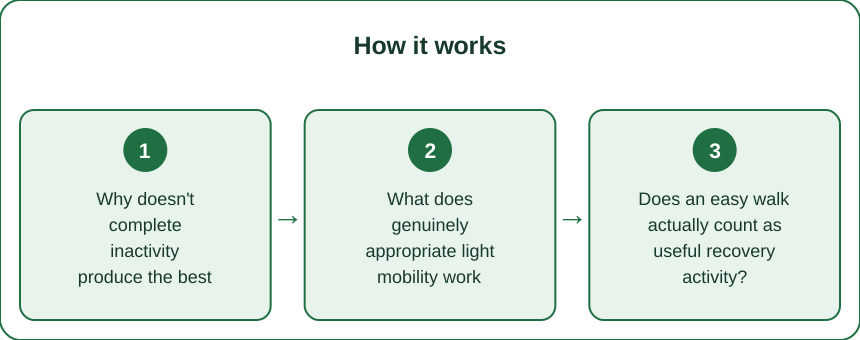
Why doesn’t complete inactivity produce the best recovery?
Light movement promotes blood flow to worked muscles, which helps clear metabolic byproducts from the previous session’s training faster than complete stillness would — this is the basic principle behind ‘active recovery,’ and it’s well-supported for calisthenics and strength training generally, not just endurance sports.
What does genuinely appropriate light mobility work look like?
Gentle range-of-motion movement through joints and muscles worked in the last session — for example, easy shoulder circles and light stretching after an upper-body-focused calisthenics session — helps maintain flexibility and reduces the stiffness that can accumulate between sessions without adding meaningful additional training stress.

Does an easy walk actually count as useful recovery activity?
Yes — a 20-30 minute easy-paced walk is one of the most accessible and effective active recovery activities, promoting general blood flow and mild cardiovascular benefit without adding any meaningful strain to muscles that need to recover from calisthenics training.
How much does nutrition and hydration actually matter on a recovery day specifically?
Adequate protein intake supports the muscle repair process that’s actively happening on recovery days, even though no new training stimulus is being added, and staying well hydrated supports this repair process too — recovery days aren’t a pause in the body’s training-related work, just a pause in adding new stimulus.
FAQ: Calisthenics Recovery Day Questions, Answered
Is it ever appropriate to have a truly full rest day with zero activity?
Occasionally, yes — particularly after a very intense session or if feeling run-down, a genuinely full rest day has its place, but as a regular pattern, some light activity tends to support recovery more than complete inactivity.
How many recovery days should a calisthenics routine include per week?
This depends heavily on training intensity and experience level, but many programs include 1-3 recovery or lighter-activity days weekly, alternating with more intensive training days.
Should stretching on a recovery day be different from a pre-workout warm-up stretch?
Yes — recovery day stretching tends to be gentler and held longer (closer to traditional static stretching) compared to the more dynamic, movement-based stretching typically used to warm up before an actual training session.
TL;DR:
- Complete inactivity isn’t the optimal recovery strategy — light movement helps more
- Gentle mobility work targeting recently-worked muscles reduces accumulated stiffness
- A 20-30 minute easy walk is one of the most accessible active recovery activities
- Protein and hydration actively support the muscle repair happening on recovery days
A good recovery day is intentionally lighter, not intentionally empty.
Keep Reading
This article is for general informational and styling purposes only. Fit, sizing, and product availability may vary.