What to Do When Bodyweight Alone Isn't Challenging Enough Anymore
Quick Answer: When standard push-ups, squats, and pull-ups stop feeling challenging, the next step isn’t necessarily adding external weight — it’s shifting to leverage-based progressions (like archer push-ups or pistol squats) and slowing down tempo before introducing any equipment at all.
Hitting a bodyweight ceiling is a natural, expected part of calisthenics progress, not a sign the approach has stopped working — there’s a structured next phase most people don’t know about before reaching for a gym membership.

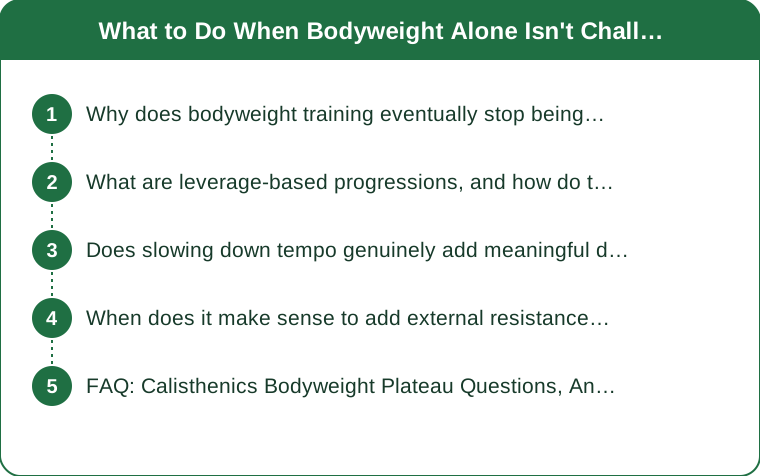
Why does bodyweight training eventually stop being enough on its own?
As muscles adapt to a fixed resistance (your own body weight), the relative challenge decreases even though the absolute resistance stays the same — this is the same basic principle behind why any fixed-weight training eventually plateaus without added resistance or difficulty. For calisthenics specifically, this typically shows up after a few months of consistent training on basic movement patterns.
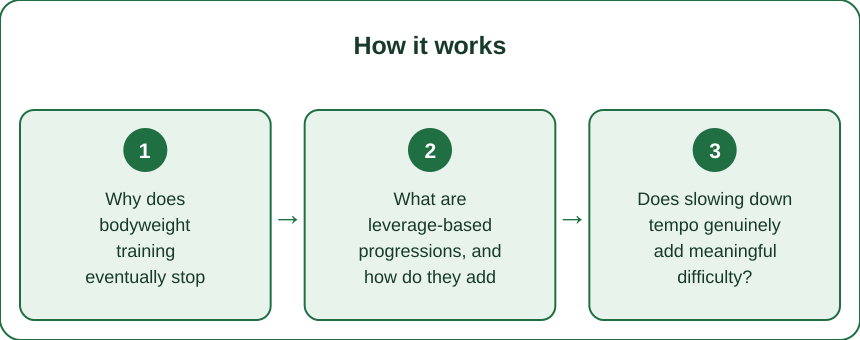
What are leverage-based progressions, and how do they add difficulty without equipment?
Leverage progressions change the mechanical difficulty of a movement without adding weight — an archer push-up (shifting weight further to one side during the movement) or a pistol squat (single-leg squat) increases the load on the working muscles substantially compared to the standard two-limb version, using body positioning rather than added resistance.

Does slowing down tempo genuinely add meaningful difficulty?
Yes — extending the lowering (eccentric) phase of a movement to 3-5 seconds increases time under tension significantly, which is a well-documented driver of strength and muscle adaptation independent of how much resistance is involved. A slow-tempo push-up can feel considerably harder than a standard-tempo one at the exact same bodyweight load.
When does it make sense to add external resistance (bands or a weighted vest)?
Once leverage progressions and tempo changes have both been explored for a movement and it still doesn’t feel sufficiently challenging, adding light external resistance — a resistance band or a weighted vest — is a reasonable next step, rather than jumping straight to equipment as the first plateau-breaking option.
FAQ: Calisthenics Bodyweight Plateau Questions, Answered
How do I know if I’ve genuinely hit a bodyweight ceiling versus just having an off day?
A true plateau shows up as a sustained pattern across several weeks, not a single difficult session — track a few consecutive sessions before concluding a leverage progression is needed.
Are leverage progressions safe for beginners to attempt?
Most leverage progressions should be introduced gradually once the standard version feels genuinely easy, since jumping too early can compromise form and increase injury risk.
Is a weighted vest a good investment for calisthenics progression?
It can be, once leverage and tempo progressions have been explored — a vest offers precise, adjustable resistance that’s harder to replicate through bodyweight alone at very advanced levels.
TL;DR:
- A bodyweight training ceiling is a normal, expected stage, not a sign calisthenics has stopped working
- Leverage-based progressions (archer push-ups, pistol squats) add real difficulty without equipment
- Slowing tempo, especially the lowering phase, meaningfully increases challenge at the same bodyweight load
- External resistance (bands, a weighted vest) makes sense once leverage and tempo options are exhausted
Before buying any equipment, try a leverage progression or a slower tempo on your current plateaued movement — it’s often enough to restart progress on its own.
Keep Reading
This article is for general informational and styling purposes only. Fit, sizing, and product availability may vary.