Does Calisthenics Training Need Different Nutrition Than Weightlifting? Here Is What Actually Changes
Quick Answer: Calisthenics doesn’t require a fundamentally different diet from weightlifting — protein needs for muscle repair are similar — but the higher relative bodyweight-to-strength demands of many calisthenics skills (like pull-ups and pistol squats) make maintaining a lean, favorable strength-to-weight ratio more directly relevant to progress than in general strength training.
You’ve probably seen calisthenics-specific meal plans marketed as fundamentally different from regular strength training nutrition. Mostly, they’re not — but there’s one genuinely important difference worth understanding.

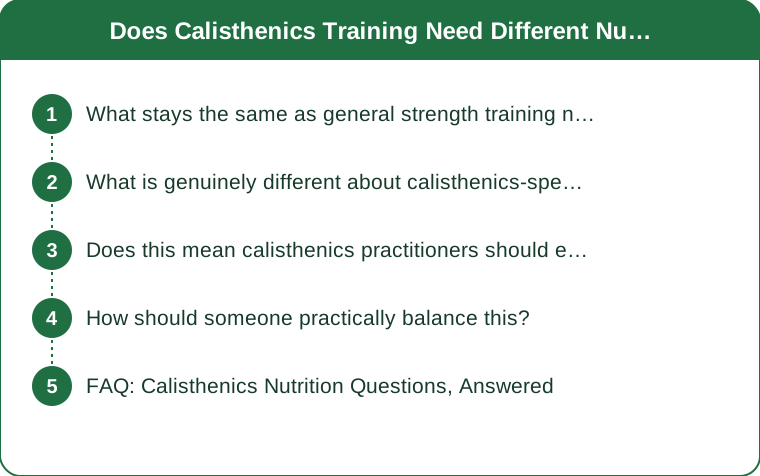
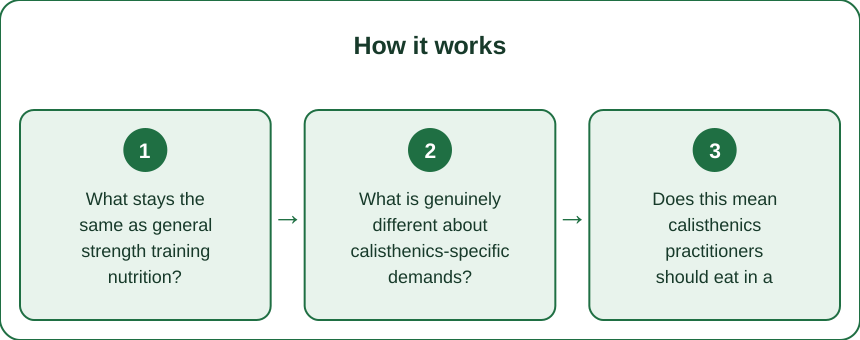
What stays the same as general strength training nutrition?
Protein needs for muscle repair and growth are essentially identical to weightlifting — roughly 0.7-1g per pound of bodyweight is a commonly cited range for people doing regular resistance training of any kind, calisthenics included. There’s no special calisthenics-specific protein requirement beyond standard strength training guidance.
What is genuinely different about calisthenics-specific demands?
Many advanced calisthenics skills — pull-ups, pistol squats, muscle-ups — require moving your entire bodyweight through a full range of motion, unlike weightlifting where you can adjust external load independently of your body composition. This makes strength-to-weight ratio a more direct performance factor in calisthenics than in general lifting, where adding muscle mass is rarely a direct disadvantage.

Does this mean calisthenics practitioners should eat in a deficit?
Not necessarily, and this is a common misunderstanding — building the strength needed for advanced calisthenics skills still requires adequate calories and protein to build muscle and support training. The point isn’t eating less, it’s being more intentional about the rate of any bulking phase, since excess weight gain has a more direct performance cost in bodyweight-based skills than in weighted lifting.
How should someone practically balance this?
A more moderate, controlled approach to any bulking phase — smaller calorie surpluses over a longer timeline rather than an aggressive surplus — tends to suit calisthenics goals better, since it builds strength while limiting the added bodyweight that skills like pull-ups and pistol squats have to move.
During a focused skill-progression phase (working toward a specific move like a muscle-up), maintaining bodyweight rather than actively bulking is a reasonable, common approach among experienced practitioners.
FAQ: Calisthenics Nutrition Questions, Answered
Do calisthenics athletes need more protein than weightlifters?
No, the general protein range for building and repairing muscle is similar regardless of whether the resistance is bodyweight or external weight.
Is it bad to gain muscle mass for calisthenics?
Not inherently — added strength matters — but added weight without a proportional strength increase can slow progress on bodyweight-based skills specifically, more so than in weighted training.
Should I eat in a calorie deficit while learning advanced calisthenics skills?
A moderate deficit is possible while maintaining strength for some people, but building genuinely new strength usually benefits from at least maintenance calories or a small, controlled surplus rather than an aggressive deficit.
TL;DR:
- Protein needs for calisthenics are essentially the same as general strength training
- Strength-to-weight ratio matters more directly in calisthenics since you move your full bodyweight
- This doesn’t mean eating less — it means being more intentional about bulking phase rate
- A moderate, controlled surplus (or maintaining weight during skill work) tends to suit calisthenics goals better than aggressive bulking
The nutrition basics don’t change much — what changes is how directly your bodyweight affects the specific skills you’re training for.
Keep Reading
This article is for general informational and styling purposes only. Fit, sizing, and product availability may vary.